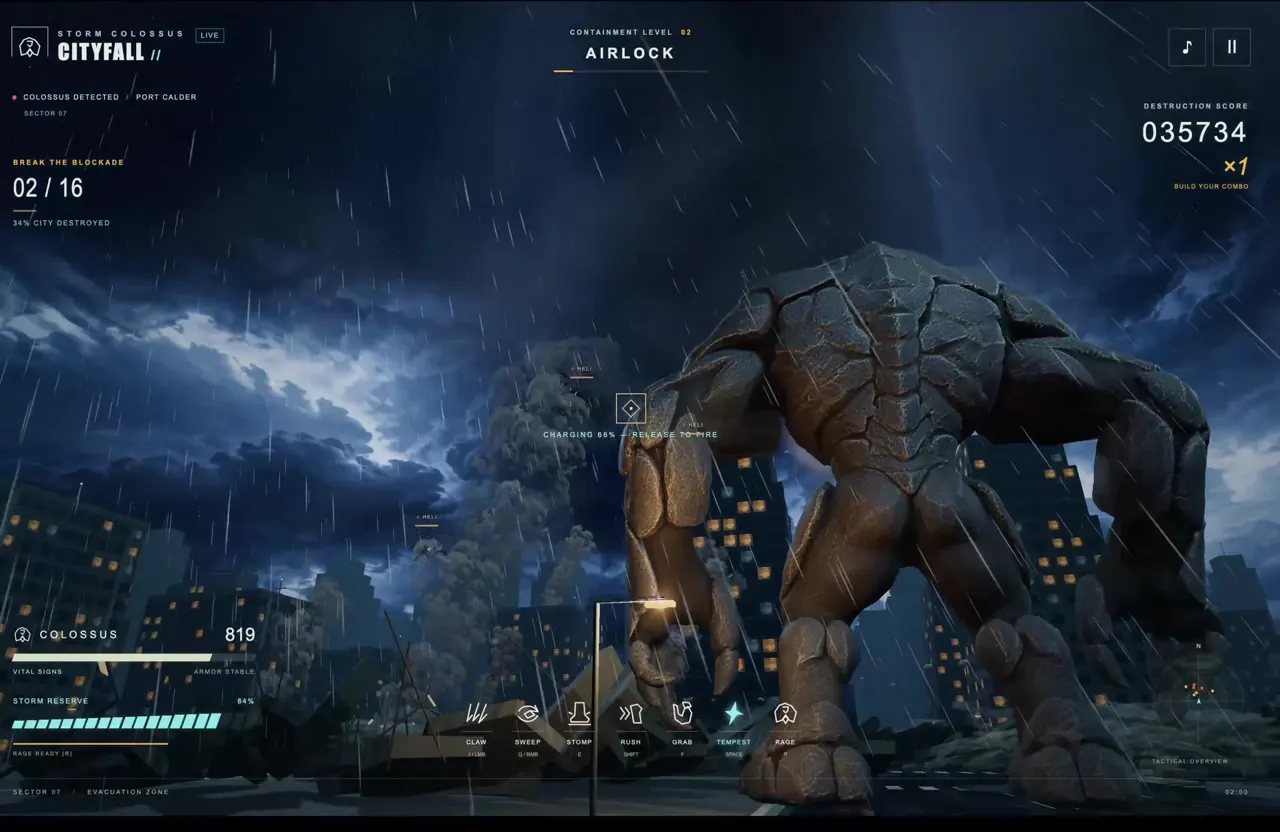
STORM COLOSSUS: CITYFALL - Complete Build Prompt
Use $threejs-game-director as the real entrypoint and build the complete game end to end. Inspect the workspace, preserve existing work, scaffold with the packaged Three.js/Vite/TypeScript starter when needed, implement the game, generate and integrate assets, profile it, playtest it, and leave the finished game running locally. Carry the work through the full playable loop, asset integration, polish, and verification.


Actually load and follow every applicable sibling skill and its required references:


* $threejs-gameplay-systems for the loop, combat, controls, camera, encounters, and physics.
* $threejs-3d-generator for the detailed hero and military assets.
* $threejs-image-generator and the available image-generation tools for references and production artwork made specifically for this game.
* $threejs-audio-generator for original sound effects, ambience, and cinematic music.
* $threejs-aaa-graphics-builder for art direction, world detail, materials, lighting, weather, VFX, and the visual scorecard.
* $threejs-game-ui-designer for the complete responsive game interface.
* $threejs-debug-profiler for runtime, animation, input, audio, rendering, and performance problems.
* $threejs-qa-release for local build validation, playtests, visual comparisons, and measured evidence.


Resolve the installed skill paths rather than assuming a particular username or home directory. Run the director's credential probe before evaluating external generation. Use available approved providers, including Tripo and ElevenLabs, through their documented tools and workflows. Keep credentials and generation requests out of browser code. Save original outputs, prompts, task IDs, and useful processing scripts. If a provider fails, record the actual error and pursue an appropriate high-quality fallback; distinguish generated, procedural, and manually authored work accurately.


Blender authoring is a specific requirement. Use Blender to inspect, repair, rig, weight, animate, and export the hero. Use its available integration or command-line interface. Save an editable .blend file with the actual rig and actions. If Blender cannot be used, report that precise blocker while completing independent work; do not describe an unverified auto-rig or a different tool's export as Blender-authored.
Game and identity
Create STORM COLOSSUS: CITYFALL, an original, fast, intense, polished third-person giant-monster destruction game set in Port Calder, a dense modern coastal city under military lockdown and a violent storm.


The player is a roughly 24-metre-tall mineral titan: massive layered basalt armor, a broad load-bearing torso, long powerful arms, heavy legs and planted feet, a compact recessed head with an articulated neck, fibrous or flexible joint regions, and a bright recessed chest core. Its body should have a distinctive silhouette and detailed PBR surfaces, with ivory-gold electrical energy inside its fissures. Design it without a tail. Preserve the detail and character of the high-quality sculpt throughout rigging and optimization.


The fantasy is overwhelming scale, weight, and momentum: punch through structures, sweep armored formations aside with a forearm, crush tanks, swat helicopters, cause seismic impacts, and discharge branching chest lightning while surviving escalating combined-arms attacks.


Make the character, name, silhouettes, artwork, creature sounds, and music original. Establish a consistent identity across the game title, menus, HUD, icons, resource names, upgrades, sound design, and signature attack. Use Tempest for the chest-lightning attack and Storm Reserve for its energy resource. The design must stand on its own without borrowing a recognizable existing franchise's creature, signature roar, or soundtrack.


Aim for a premium, cinematic browser game with the attention to motion, lighting, sound, and interaction associated with AAA games. Match that ambition to measured browser budgets and describe the techniques honestly.
Design target and core loop
* Deliver a concentrated 8–12 minute arcade run, with six authored waves, a signature boss encounter, and escalating endless play afterward.
* Put a vulnerable structure and an immediate military threat near the starting position. The first meaningful choice and first satisfying destructive payoff must happen within 15 seconds.
* Core loop: destroy military forces and city structures → build combo, rage, and Storm Reserve → spend those resources on stronger attacks → survive increasing pressure → choose an upgrade or recovery → face the next escalation.
* Reward attack selection, animation timing, target priority, positioning, evasion, grabbing and throwing, maintaining combos, and choosing when to discharge Tempest.
* Include vitality, stagger resistance, Storm Reserve, rage, destruction percentage, combo multiplier, score, wave progression, and fast retry.
* Destruction and military kills produce readable resource rewards. Tempest cores, recovery items, and useful salvage should remain easy to recognize in the storm.
* Offer three choices between waves from a compact pool: stronger Tempest, wider forearm sweep, armor regeneration, faster reserve gain, larger stomp radius, projectile reflection, longer rage, or improved movement power. Make upgrades alter play rather than only changing score values.
* Maintain city damage throughout a run. Restart must cleanly restore the city, player, enemies, resources, effects, and audio.
* Write a concise design brief, core-loop contract, encounter plan, difficulty curve, and non-goals before implementation, then verify them in actual play.


Keep the scope focused on the arcade destruction game. Civilian injury simulation, multiplayer, and an open-world story are outside the scope.
Combat and unified input
Route keyboard/mouse, gamepad, and responsive touch controls through one intent layer. Keep gameplay independent of individual input devices.


Action
	Keyboard / mouse
	Gamepad
	Move
	WASD
	Left stick
	Look / orbit / aim
	Mouse
	Right stick
	Toggle cinematic / third-person camera
	C
	Provide a documented equivalent where practical
	Third-person zoom
	Mouse wheel
	Provide an accessible equivalent where practical
	Three-hit claw / crushing combo
	Left mouse or J
	A
	Wide forearm sweep
	Right mouse or Q
	B
	Seismic stomp
	E
	X
	Armored rush
	Shift
	LB
	Grab / throw
	F
	Y
	Tempest chest lightning
	Tap / hold Space
	Tap / hold RT
	Roar / rage
	R
	RB
	Pause / settings
	Escape or P
	Start
	Mute
	M
	Settings
	Fast restart
	T
	Menu control


* Primary attack is a three-hit sequence with distinct anticipation, contact, and recovery. Include a powerful two-arm crushing finisher. Support buffered inputs and authored cancel windows.
* Forearm sweep has a wide readable arc, real arm articulation, strong lateral knockback, and directional feedback.
* Stomp damages vehicles and foundations with a radial seismic impact.
* Rush accelerates into an armored forward charge through light structures and enemy formations. Constrain steering enough to convey commitment while retaining responsive control.
* Grab accepts suitable tanks, physical debris, and selected structural chunks. Show valid targets, carry them convincingly, and aim throws toward the player's intended target.
* Rage creates a radial stagger and temporary power state with clear duration and meaningful combat benefits.
* Explain blocked actions, insufficient reserve, cooldowns, and incompatible carried objects on screen. Inputs must never appear to fail silently.
* Prevent Space and wheel input from scrolling the page during gameplay. Do not consume game shortcuts while the player is interacting with a focused settings control.
* Restore appropriate game focus after closing overlays. Use a user gesture for pointer capture and audio unlock; handle capture failure and pointer-lock loss gracefully.
* Touch controls include movement, a separate drag-to-look area, and all seven combat actions. Tap and hold semantics must match the other devices.


Movement must feel massive and fluid. Use acceleration and deceleration, deliberate weight shifts, turn anticipation, planted feet, bounded attack steering, animation blending, brief hitstop, restrained impact shake, and synchronized feedback. Make small corrections easy. Keep the next threat visible.
Two polished camera modes
C toggles between two complete modes:


1. Cinematic overview: a wider elevated view that communicates city scale, surrounding enemies, and destruction.
2. Third-person follow / free orbit: a closer, fully controllable camera that follows the Colossus through movement and turns while letting the player look around independently.


The third-person mode must include:


* Continuous 360-degree yaw and generous vertical freedom. Allow looking upward at aircraft and storm clouds and downward toward the ground; roughly 70 degrees up and 80 degrees down are useful starting limits.
* Mouse, right-stick, and touch look with sensitivity control and low-latency, frame-rate-independent smoothing.
* A stable follow pivot derived from the character's world motion, not individual footstep or torso animation oscillations.
* Gentle movement-based recentering only after manual look has been idle. Manual input takes priority immediately. Recentring must not create a feedback loop that rotates the player's movement into a spiral.
* Camera-relative movement with a consistent relationship between movement intent, character facing, and camera yaw. Preserve a held movement direction when automated recentering would otherwise change it unexpectedly.
* Mouse-wheel zoom with a useful but bounded range. Start near a 34-metre follow distance and tune approximately 28–62 metres to the final character scale. Zoom out far enough to inspect a broader overhead view, then smoothly return close.
* Retain the chosen zoom across camera toggles. Combine zoom and pitch naturally without sudden angle changes or forced resets.
* Building and ground avoidance using a boom sweep or equivalent conservative collision test. Retract smoothly near obstacles, recover smoothly when clear, and avoid oscillation at corners. Keep desired zoom separate from temporary collision retraction.
* Smooth transitions between modes, including during movement and combat.
* Pointer-lock support for unrestricted mouse travel. If unavailable, provide a tested focused-canvas fallback that still permits continuous turning.


Camera stability is a completion requirement. Store the unshaken follow position and orbit state separately from temporary shake offsets. Never feed the previously shaken camera position back into the follow spring. Smooth fixed-step physics motion before rendering, handle yaw wrap correctly, and limit close-camera shake. Test turning, rushing, building contact, explosions, and changes in frame rate for jitter or wobble.


Pressing, holding, releasing, or finishing Space must preserve the player's camera yaw, pitch, zoom, shoulder offset, and field of view. Do not switch to an attack camera, rotate toward an enemy, force recentering, or move the camera to expose the effect. Make the attack readable from the existing view. A small temporary impact impulse may be layered on top without changing the underlying framing. Preserve this behavior in both modes.
High-quality hero, Blender rig, and full-body animation
Generate references specifically for Storm Colossus before modeling. Create a full-body neutral reference with separated limbs, visible feet and hands, readable joint boundaries, distinct armor and flexible material zones, and an unobstructed chest core. Use plain-background front, side, back, and three-quarter views where useful.


Generate the strongest detailed PBR hero through the 3D asset workflow, then bring it into Blender. Inspect topology, disconnected parts, material assignments, transforms, scale, and bind pose. Run available rig-readiness checks, but author or repair the skeleton for this creature's actual anatomy.
Rig and skinning requirements
* Build meaningful pelvis, spine, chest, neck/head, clavicle, upper/lower arm, hand/finger, thigh, shin, ankle, foot, and toe chains. Choose the bone count from the anatomy; roughly two dozen well-placed bones is a starting point, not a substitute for deformation quality.
* Place joints from anatomical landmarks. Preserve correct bind orientations through export and runtime loading.
* Weight limbs using spatial regions and mesh connectivity. Nearby arms, thighs, shins, and toes must not accidentally share influence simply because they overlap in the rest pose.
* Normalize weights and inspect them in Blender. Validate that no vertex is significantly driven by unrelated arm and leg chains; use a small reported threshold, such as 2%, to detect contamination.
* Keep broad back and chest armor stable. Use segmented armor, better topology, corrected weights, or corrective deformation as appropriate to avoid rubbery stretching and collapsing surfaces.
* Keep hands and forearms clear of legs through locomotion and attacks. Check extreme poses, deep bends, and animation crossfades for limb clipping, stretched triangles, twisted joints, and broken seams.
* Ground the soles correctly. The feet must not sink through streets, curbs, or the terrain during movement and attack impacts. Correct pivots, root height, support queries, and IK rather than hiding bad grounding inside the floor.
* Save the detailed sculpt, rig, weights, packed textures, and actions in the editable .blend. Preserve original generation sources separately from optimized runtime assets.
Animation requirements
Author and bake real clips for idle/breathing, walking, running/rushing, turning, claw strikes, forearm sweep, two-arm crushing strike, stomp, Tempest charge/fire/recovery, hurt, and defeat. Shared or layered actions are acceptable when the resulting motions remain distinct and polished.


* Animate the whole body: pelvis transfer, spine compression, shoulder counter-rotation, arm follow-through, hand and finger movement, neck/head tracking, breathing, recoil, and settling after impacts.
* Long heavy arms should have deliberate arcs and delayed recovery. The head and neck should respond to turns and actions. Avoid a stiff torso with only the legs cycling.
* Use creature-specific timing, balance, and centre of mass. Generic human walking or jogging applied unchanged is insufficient for this character.
* Use foot IK and deliberate stance/swing phases while authoring. Match locomotion cycles to actual travel speed, then bake valid animation data for export.
* Blend through AnimationMixer transitions with sensible interruption and recovery rules. Procedural secondary motion must enhance the baked clips without accumulating drift or destroying the bind pose.
* Drive turning inertia and chest-charge overlays in a stable local space. Repeated zero-delta updates, pause/resume, and restarts must not progressively deform the model.
* Strip or retain root motion deliberately using the documented import workflow. Do not combine baked root translation with a second gameplay translation that causes sliding or double motion.
* Attach the chest emitter, hand effects, foot contacts, and relevant collision proxies to actual animated sockets or bones.
* Trigger impact damage, sound, debris, and shake at authored contact markers. Windup, contact, and recovery are separate phases.


Validate the deformed mesh, not just bone positions. Sample every clip across its duration in Blender and at runtime, inspect front/side/three-quarter motion captures, and measure foot penetration, stance drift, abnormal stretch, and cross-chain weighting. Include transitions and the most extreme attacks. Report actual findings and repair failures before accepting the hero.
Military assets, waves, and enemy behavior
Generate at least one premium tank and one attack helicopter through Tripo or the available equivalent. Create distinct optimized variants with authored turrets, missile racks, armor, rotors, sensors, decals, materials, damage states, and LODs.


Animate tracks, turret tracking, gun recoil, rotor assemblies, banking, hit reactions, and crash behavior through appropriate hierarchies. Preserve nearby detail while reducing distant geometry.


Wave
	Encounter
	Skills and pressure
	1 — Breakwater
	Assault tanks
	Melee, stomp, long readable cannon tells
	2 — Airlock
	Attack helicopters with light armor
	Free camera look, Tempest, grabbing and throwing
	3 — Crossfire
	Mixed armor, air attacks, and missiles
	Target priority, positioning, reserve management
	4 — Blackout
	Artillery and EMP tanks protected by agile gunships
	Interrupt disruptors and evade impact zones
	5 — Redline
	Elite formations and coordinated salvos
	Sustain combos, use rage, exploit destruction lanes
	6 — Extinction Protocol
	Super-heavy siege crawler and VTOL command gunship
	Phases, exposed cores, reinforcement control, recovery windows
	Endless
	Escalating combined-arms formations
	Density, composition, accuracy, aggression, hazards, and elite modifiers


Build a memorable boss payoff with weak points, telegraphed attacks, reinforcement phases, punish windows, and dramatic wreckage. Escalate endless play through tactics and composition as well as durability.


Use silhouettes, anticipation, targeting lines, warning sounds, muzzle flashes, missile trails, ground impact zones, and off-screen indicators to make attacks readable. Enemies reposition, maintain engagement ranges, avoid obvious clustering, and react physically to hits. Destruction opens lanes and removes cover.
Physics and destruction that respect the Colossus
Use Rapier with a fixed 60 Hz timestep. Separate render meshes from simplified collision shapes. Use explicit collision groups, sleeping, bounded body counts, and cleanup on reset. Enable continuous collision detection where fast projectiles, flying rubble, or relative player motion could otherwise tunnel through a collider.
Player contact is mandatory
* Give the Colossus a solid torso/body collider, with additional kinematic limb volumes following the actual animated arms and feet. A torso volume plus approximately six limb capsules is a useful starting layout; tune them to the sculpt and animations.
* Interpolate player translation, rotation, and bone-driven proxy motion across fixed steps. Do not teleport collision proxies once per rendered frame and expect reliable contact.
* Explicitly verify collision masks between the player, physical rubble, building fragments, vehicles, wrecks, and world geometry. Combat hit sensors do not replace solid body contact.
* Falling fragments must strike, deflect, slide around, or be pushed away from the Colossus. Running through a collapsing building must visibly displace its sections rather than letting them pass through the torso and arms.
* Use conservative swept contact or equivalent protection for fast relative motion and large architectural pieces. Tune friction, restitution, mass, and solver quality for heavy concrete and steel.
* Instanced or manually simulated architecture, slabs, gravel, and visual debris must also respect the relevant player volumes. Using a different simulation path is not an excuse for visible pass-through.
* Ruins remain interactive after settling. Re-entering rubble should produce contact, displacement, and appropriate dust or impact feedback.
* Expose collision proxies in development diagnostics so their alignment with the animated hero can be inspected.
Hybrid structural destruction
* Create at least six modular building archetypes with distinct footprints, rooflines, setbacks, entrances, windows, signage, rooftop equipment, interiors, and damageable structural regions.
* Support four readable stages: intact → cracked/scorched → breached/burning → partial or full collapse.
* Use structural dependencies so damage to foundations or load-bearing zones can cause delayed upper-section failure.
* Detach recognizable facade sections and fracture clusters. Expose interior floors, broken columns, rebar, scorched openings, and damaged roof assemblies.
* Stage collapse with directional weight: cracking, facade peeling, floor failures at varied times, falling slabs, secondary contacts, and a settling rubble pile. Avoid synchronized fragments radiating from a single point.
* Apply real nearby rigid-body simulation to important chunks. Pool and instance smaller debris, glass, embers, dust, and smoke for volume while retaining conservative player contact.
* Start with bounded budgets such as 36 desktop / 18 mobile physical chunks and a larger 480 / 240 architectural-piece pool, then tune from evidence. Prioritize nearby visible events.
* Preserve recognizable rubble silhouettes and major damage within a run; recycle minor particles and distant nonessential debris gracefully.
* Tanks can skid, flip, shed turrets, burn, and detonate. Helicopters lose control, trail smoke, collide with geometry, and leave wrecks.
* Add pavement cracks, craters, bent street furniture, displaced parked cars, shattered glass, and persistent scorch marks to communicate the path of destruction.


The objective is dramatic, grounded, readable destruction within a browser budget. Document which pieces use rigid bodies and which use authored or simplified simulation. Do not describe every fragment as physically simulated unless that is true.
Tempest: reliable input, precise aiming, visible lightning
Tempest emits branching ivory-gold lightning from the animated chest core. Its origin and visual language must match the original mineral titan.
Input and lifecycle
* Tap Space for an immediate minimum burst when reserve is available, including brief taps of roughly 45–70 milliseconds.
* Hold Space to charge; releasing early fires the accumulated charge. Reaching full charge fires automatically so continuing to hold cannot leave the player stuck waiting.
* A sustained discharge consumes reserve with clear duration and power feedback. Require release before another automatically triggered shot; avoid repeated firing from a continuously held key.
* Show charge progress, usable reserve, cooldown or action restrictions, and insufficient-resource feedback.
* Charge audio and charge-only VFX stop or fade cleanly when firing, cancellation, pause, defeat, or restart occurs.
Aim and impact
* Place the reticle at the actual rendered camera centre on desktop and mobile.
* Trace from that camera centre to obtain an intended world target. Then trace from the animated chest emitter to that target to resolve the real shot path.
* Respect buildings, ground, and nearby obstacles between the chest and target, even if the camera can see past them.
* Use the same resolved path and hit point for damage, lightning geometry, impact light, sound position, scorch marks, and any impact marker.
* Aim correctly at both ground vehicles and high aircraft across the full permitted pitch range. Validate axes, world transforms, aspect ratio, and camera mode changes.
* Do not silently snap to an off-axis enemy. If the line hits a wall, the wall receives the impact and blocks damage behind it.
* Display a restrained contact marker during charge/fire so the player can see where the attack will land.
* Preserve camera orientation and framing throughout the entire lifecycle, as specified above.
Effect readability
Build a clear charge gathering into the chest fissures, bright core, multiple jagged primary lightning trunks, smaller forks, turbulent corona, local light, sparks, rain vapor, material scorching, and a pronounced impact flare. Update the emitter every rendered frame and keep the discharge visually continuous during locomotion and turning.


The attack must be obvious against dark streets, lit windows, clouds, smoke, and dense combat without washing out the scene. Tune thickness and brightness from actual gameplay captures at close, wide, and overhead distances.
Art direction, references, and authored city
Use a cinematic blue-hour coastal storm: cool slate cloud light, dark wet concrete and asphalt, pale mineral highlights, warm street lamps and occupied windows, amber/red military warnings, orange fire, and ivory-gold Tempest energy. Give the environment deliberate contrast, depth, and material separation.


Generate visual references for this game specifically. Create a Storm Colossus character sheet and a gameplay-oriented storm-city target showing this creature, this palette, this scale, and relevant camera framing. Use those references and the game's own captures to guide critique. Do not use screenshots from an unrelated game as if they represented this project. Clearly distinguish concept art from implemented gameplay evidence.


Build a dense authored district with streets, intersections, plazas, overpasses, waterfront cranes, transit structures, parks, barricades, parked vehicles, street furniture, signs, rooftop equipment, foreground scale cues, layered midground districts, and a distant skyline. Vary building proportions and street composition. The playable space should have memorable routes and landmarks.


Use a reusable modular kit, trim sheets, atlases, decals, shared materials, instancing, culling, and LODs. Generate and integrate useful facade and road references, damage decals, faction markings, sky/cloud artwork, logo, ability symbols, upgrade icons, wave emblems, and menu/loading art. Keep unused experiments outside runtime assets.
Trees and foliage
Create convincing branching trunks, secondary branches and twigs, bark variation, irregular layered crowns, leaf clusters or veined leaf cards, root/planting details, and species/size variation. Add restrained wind response and interaction with nearby destruction. Ground foliage with contact shading and appropriate planting beds. Use good distant silhouettes and lower-density mobile LODs. Trees must read convincingly from the close and overhead camera modes.
Storm, smoke, lighting, and VFX
Weather and atmosphere
* Render visible rain with near/far layers, varied streak lengths, wind, and depth. Use world-space motion or a stable camera-relative volume that does not visibly swim during turns.
* Suppress rain beneath intact roofs where practical. Add pavement and rooftop splashes, puddle ripples, runoff cues, and low drifting street mist.
* Use a detailed cloud ceiling with animated density layers and depth variation. Clouds should contribute to the environment light and wet reflections.
* Add intermittent branching lightning that illuminates a localized cloud bank and affects the scene. Delay thunder according to distance. Reduce or suppress flashes under reduced-motion settings.
* Balance distant haze and foreground clarity so the character silhouette, feet, targets, and military tells remain readable.
Lighting and materials
* Establish key, fill, and rim separation with environment lighting, grounded contact shadows, selected real shadows, and warm practical street lighting.
* Make the hero's layered armor and flexible joints readable in motion. Keep the chest core and attacks bright without losing surface texture.
* Use physically plausible wet asphalt, puddle masks, restrained reflections, roughness variation, concrete runoff, dirt, broken glass, and varied window occupancy.
* Add bounded local illumination for lamps, muzzle flashes, fire, lightning, and impacts. Include reflection and shadow passes in performance accounting.
* Use ACES tone mapping or a deliberately chosen equivalent, controlled bloom, and restrained finishing effects. Preserve highlight detail and deep-shadow readability.
Smoke and destruction effects
* Use textured billows with internal density, shading, irregular silhouettes, rotation, growth, wind advection, rising plume development, and dissipating edges.
* Separate heavy ground-level demolition dust from rising fire smoke. Add smaller ash, grit, glass, sparks, and embers where appropriate.
* Let explosions and lightning briefly illuminate the smoke. Avoid uniform opaque puffs and obvious repeated flat circles.
* Deduplicate building plumes so each failing floor does not spawn another full-volume effect. Maintain bounded lifetimes and active counts.
* Preserve a readable corridor around the player and incoming threats without making effects visibly disappear around the camera.
* Stomp adds pavement fracture cues, radial shockwave, a rolling dust front, launched rubble, knockback, and a localized impact impulse.
* Forearm hits add directional air arcs, contact sparks or dust, and readable displacement.
* Give tanks, helicopters, structural collapses, and the boss distinct failure sequences and secondary detonations.
* Rage alters posture, core/fissure emission, material response, impact effects, HUD, sound, and enemy reactions coherently.


Fog, darkness, bloom, particles, and shake must support the authored scene rather than conceal missing geometry, bad skinning, weak collisions, or unreadable attacks.
Original cinematic sound design
Use $threejs-audio-generator for a complete original audio pass. The player should hear the Colossus's mass, military pressure, storm depth, and the material violence of destruction. Evaluate the mix in real combat, not only isolated files.


Create and integrate an event matrix with at least:


* Several ordinary footfall variants: heavy low-frequency impact, concrete fracture, displaced grit, and a short body resonance.
* A distinct seismic stomp: anticipation or movement sound followed by one powerful landing transient, deep pressure wave, and settling rubble. Trigger it at the actual animation contact/damage event, not during windup.
* Claw strikes, forearm swings, crushing impacts, rush movement, grab/throw, creature breathing, mineral body movement, hurt, roar, and defeat.
* Tempest charge, launch, sustained current, and release as separate stages. Combine a controlled electrical build, powerful launch transient, substantial bass body, textured arcing sustain, and an audible termination. Avoid thin repetitive beeps, harsh clipping, or a generic sci-fi toy sound.
* Tank diesel and track movement, several cannon reports with recoil/mechanical character, punchy autocannon/gun bursts, missile launch/flight/impact, rotor loops, and aircraft failure.
* Steel stress, structural fracture, concrete avalanches, close impacts, debris settling, explosions with secondary detonations, and burning wrecks.
* Rain, distant thunder roll, nearby thunder crack, distant battle, city ambience, and local fire.
* Distinct combo, upgrade, warning, pause, confirmation, and defeat UI sounds.
Mix and runtime behavior
* Use separate master, SFX, weapons, UI, ambience, creature/voice, and music groups, with accessible volume controls and mute.
* Preserve convincing sub-bass while providing enough low-mid impact to remain audible on ordinary speakers. Keep cannon, gun, footfall, stomp, and Tempest transients clear in the full mix.
* Give player impacts and major threats priority. Use bounded concurrency, distance attenuation, stereo/spatial placement, modest pitch variation, and selective reverberation.
* Duck music and competing ambience briefly for stomp, launch, roar, and major collapse, then recover smoothly. Keep weather from masking weapon reports.
* Trim unintended leading silence, control peaks and loudness, and verify generated formats decode in the browser.
* Audio, damage, VFX, and shake must derive from the same authored events. Hitstop and frame-rate changes must not duplicate cues or move them away from contact.
* Ordinary footsteps follow actual stance contacts; stomp plays exactly once at its landing event. Do not infer success merely from a sound file being loaded.
* Unlock audio on a user gesture. Deduplicate loops, stop canceled charge sounds, preserve intended pause/resume offsets, and clear sources on restart or disposal.
* Record a real gameplay mix. If subjective listening is available, audition it and refine it; if unavailable, report that limitation and provide the recording alongside signal and trigger checks.
Original music that fits the game
Use the audio skill and ElevenLabs Music capability, where available, to compose an original instrumental score with a dark orchestral monster-march identity: low brass, bowed basses, deep percussion/taiko, restrained metallic textures, and a memorable ominous motif. It should convey immense scale, dread, and escalating resistance while leaving room for impacts and weapon sounds.


* Produce at least two substantial, loopable cues or compatible stems: a lower-intensity dread cue for approach/regular combat and a stronger siege cue for late waves, bosses, and rage.
* Aim for roughly 90 seconds or more of useful material per cue, with seamless or professionally crossfaded loop boundaries and no long silent introduction.
* Keep harmonic/rhythmic material compatible when layering; otherwise use musically sensible transitions. Use smooth equal-power intensity changes without restarting the score on each event.
* Drive intensity from actual wave and combat state. Handle menu, pause, defeat, restart, boss transitions, and rage intentionally.
* Provide a separate music volume control. Normalize and equalize to retain headroom and leave the important SFX audible.
* Verify actual loop wrap, repeated start/resume, intensity transitions, mute, and cleanup. Avoid stacked duplicate tracks, abrupt cuts, or audible loop seams.


Do not request imitation of a named artist, film theme, or existing soundtrack. Retain composition prompts, source files, processing parameters, and provider IDs.
HUD, menus, and page metadata
Create an authored cinematic monster-game HUD with a consistent Storm Colossus identity. Include vitality, segmented Storm Reserve, rage state, wave/radar information, destruction objective, score/combo feedback, boss health, threat indicators, upgrade selection, pause/settings, loading, milestone/victory, defeat/retry, and touch controls.


* Use original logo and ability artwork where useful. Give menus a strong typographic hierarchy and integrate the generated game-specific background coherently.
* Keep active-play HUD coverage restrained. Avoid generic dashboard cards and excessive panels.
* Make the centred reticle, charge state, contact marker, and blocked-action feedback legible in rain and smoke.
* Support desktop, phone portrait, and phone landscape with safe areas, stable numeric widths, text fit, clear focus/hover/pressed states, and touch targets of at least 44 CSS pixels.
* Include camera sensitivity, shake strength, reduced motion, adaptive/high/performance quality, and the relevant volume controls.
* Add static HTML page metadata: descriptive title, description, Open Graph title/type/site name/description/image/alt text/dimensions, and an X/Twitter large-image card. Use this game's artwork and include no personal username or attribution handle unless supplied.
* Keep the canonical URL and absolute social-image origin configurable from a single base-URL setting. Do not invent a live address. Social metadata must be available in the initial HTML rather than relying on game JavaScript to create it.
Technical architecture and performance
Use Three.js, TypeScript, Vite, and Rapier with clear boundaries between input, simulation, animation, camera, world, UI, audio, effects, asset loading, and diagnostics. Route gameplay randomness through seeded RNG.


Start within these budgets and tune from measured scenes:


Budget
	Desktop
	Mobile tier
	Frame-rate target
	60 FPS
	Stable 30–45+ FPS
	Draw calls
	At most 300
	At most 150
	Rendered triangles
	At most 750,000
	At most 300,000
	DPR cap
	2
	1.5
	Shadow-casting lights
	At most 2
	Reduced or disabled as needed


Use shared geometry/materials, instancing, pooled VFX, texture atlases and suitable compression, frustum/distance culling, LODs with hysteresis, adaptive quality, and explicit disposal. Budget cloud, rain, smoke, reflection, shadow, and post-processing work as well as visible meshes. Reduce mobile cost through deliberate particle, reflection, shadow, debris, foliage, and model tiers while preserving important interactions.


Avoid unbounded allocations, bodies, sounds, lights, particles, and event listeners. Keep source art, editable Blender files, credentials, and provider manifests outside runtime public assets where they are not needed by the game.


Expose renderer and physics diagnostics through __THREE_GAME_DIAGNOSTICS__. Implement deterministic __THREE_GAME_TEST_HOOKS__ for active play, Tempest, collapse, late wave, boss, stress, pause, upgrades, and defeat. Gate intrusive debug interfaces and test controls to explicit development/test use.
Verification and definition of done
The game is complete only when all of the following are demonstrated:
Playable loop
* All six waves, boss phases, endless escalation, resources, upgrades, failure, and fast retry work.
* Real keyboard/mouse, gamepad, and touch input drive the shared intents correctly.
* The first meaningful decision and destructive payoff happen within 15 seconds.
* A bot playtest covers movement, combat, scoring, progression, failure, and retry at two reaction levels. Report measured outcomes.
Hero motion and contact
* The detailed generated hero is integrated at the right scale with its real Blender-authored rig and exported actions.
* Inspect actual deformed geometry in every clip and important blend. Arms, shoulders, neck/head, hands, torso, and feet visibly participate in movement.
* No severe back warping, arm/leg weight contamination, exploding triangles, visible floor penetration, or persistent foot sliding remains in the tested states.
* Validate grounding and drift while the game applies real movement, including rush and deep attack poses. Check reset and repeated zero-delta updates for accumulated deformation.
* Supply motion recordings or multi-frame evidence; a neutral-pose screenshot is insufficient.
Destruction collisions
* Drive the Colossus through an intact and a collapsing building. Major falling sections contact and move around the torso and limbs.
* Throw or launch a physical chunk into the body; verify actual collision response.
* Demonstrate an animated arm contacting debris, a rush displacing a slab, and re-entry into settled rubble.
* Test both the rigid-body pool and the instanced/manual architectural pool, including fast motion and rotated poses.
* Confirm debris budgets stay bounded and restart clears the simulation.
Tempest and camera
* Brief Space taps fire; early release fires; full hold fires automatically; insufficient energy explains the restriction; a held trigger cannot endlessly retrigger.
* The reticle ray and chest-emitter trace agree. A building between the chest and an enemy blocks damage. Ground and high-aircraft aiming both work.
* The lightning and impact are clearly visible at close, wide, and overhead distances in real combat.
* Space leaves underlying camera orientation, zoom, offset, and FOV unchanged in both camera modes.
* Real C toggles, 360-degree look, vertical limits, wheel zoom limits, saved zoom, camera collision, smooth turns, and page-scroll prevention pass.
* Shake introduces no drift into the stored follow solution. Movement/recentring does not cause spiralling or wobble.
Audio, atmosphere, and interface
* Actual gameplay events trigger audible cannon/gun sounds, heavy footsteps, one stomp impact at contact, structural rumbles, and all Tempest stages.
* All audio decodes; loops deduplicate; music transitions and loop wraps work; pause/resume, mute, and restart are clean. Report peaks and provide a mixed recording.
* Rain, cloud motion, wet lighting, smoke development, and lightning/thunder have visible or audible contributions in the game itself. Use isolated comparisons where a feature is hard to judge.
* Desktop, phone portrait, and phone landscape interfaces fit, remain readable, and expose the complete controls.
* Static metadata is present and references a real included preview image with correct dimensions; a supplied base URL resolves consistently.
Build, visual quality, and evidence
* The local production build and preview pass without console, page, network, asset-loading, or WebGL errors.
* Capture desktop and mobile active play, Tempest, major collapse, late-wave/boss combat, pause/settings, upgrades, and defeat/retry. Include close and overhead camera views.
* Run the canvas inspector for desktop/mobile with pixel metrics, GPU/renderer information, scene counts, physics counts, and budget comparisons.
* Use a deterministic visual regression harness for critical states. Review intentional baseline changes and run a separate comparison afterward.
* Complete the graphics skill's 10-category scorecard on its 0–3 scale, with every category at least 2 and an average of at least 2.3. Base the assessment on actual active-play evidence and improve the weakest categories before handoff.
* Distinguish measured frame rates from targets, emulator results from physical-device tests, signal checks from subjective listening, and concept art from rendered gameplay. State remaining limitations precisely.


Finish with the game running locally and a concise handoff containing the local URL, controls, editable Blender source, runtime assets, generation provenance, rig/deformation checks, collision tests, audio/music validation, renderer/physics metrics, screenshots or recordings, test results, scorecard, and remaining risks.


Make strong routine implementation decisions autonomously. Keep working through integration, repair, visual iteration, profiling, and QA until the intended game is playable and the evidence supports the result. Keep progress updates concise and focused on findings. Only ask for information or access that is actually required to proceed.
Make it yours. Rewrite the "Game and identity" section (STORM COLOSSUS: CITYFALL, Port Calder, the 24-metre mineral titan) and the core loop for your own game, and keep the opening paragraph and the list of $threejs-* skills, which route the build through the skill pack.
Kaiju battle in a storm-hit city
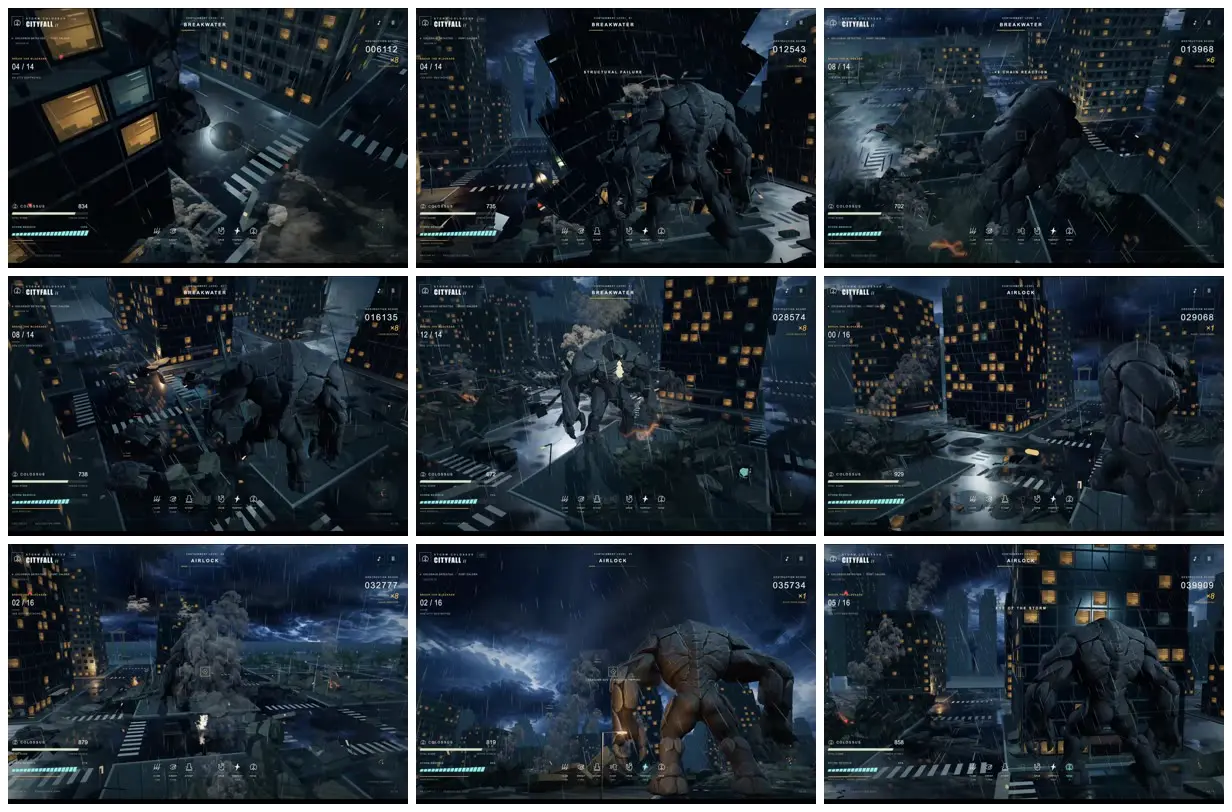
Storm Colossus: Cityfall. Play a stone titan smashing through a rain-soaked city at night for a destruction score. GPT-6 Astra built it from a 15-page prompt driving the creator's Three.js game skill pack, with Tripo models and ElevenLabs sound.
“prompts like this will typically get the game to ~80% in one shot, you will want to spend time on polishing”
You'll need
- The creator's threejs-game-skills pack (the prompt starts from $threejs-game-director)
- Tripo and ElevenLabs accounts for the generated models and sound
- Blender, which the prompt asks for to rig and animate the hero
How it was made
The creator says the 3D models came from Tripo and the sound from ElevenLabs, and that "prompts like this will typically get the game to ~80% in one shot, you will want to spend time on polishing with skills like threejs-aaa-graphics-builder". How much polishing this build got isn't stated. The prompt starts from his $threejs-game-director skill and names eight sibling skills; it also asks for Blender to rig and animate the hero. The text here is the Google Doc's plain-text export.
GPT-6 Astra · Three.js · Vite · TypeScript · Tripo · ElevenLabs · threejs-game-skills
Source and credit
X · Sep 5, 2026 · 205 likes · 18k views · 16 comments
Authorship not stated by the source
Published instructions: Google Doc linked in a reply on X
Look notesby Reference
A dark stone titan with cracked armor stomps through a city of lit tower blocks in a night storm, wrecking buildings amid smoke, rain, and lightning.
- Color
- Storm blues and near-black, warm amber window light, grey smoke and rubble, white lightning, and a few orange fire glints; the HUD is white with a cyan energy bar.
- Type
- A STORM COLOSSUS CITYFALL logo in the top left, a zone name at top center (BREAKWATER, AIRLOCK), a six-digit destruction score with a multiplier in the top right, objective counters (04/14, 02/16), callouts (STRUCTURAL FAILURE, EYE OF THE STORM), and ability icons along the bottom.
- Framing
- Wide 3:2 frames from a third-person camera behind and above the titan, with towers framing the streets on both sides.
- Sound
- Sound from ElevenLabs, according to the creator.
- Structure
- Close among the towers, the titan crashing into a building with STRUCTURAL FAILURE, a chain reaction, street fighting in smoke and debris, a new zone, AIRLOCK, a wide view of the storm-lit city, the titan facing the skyline under lightning, and EYE OF THE STORM.