You are given source material from the user. It may be text, images, PDFs, notes, screenshots, slides, transcripts, or mixed materials.

Transform it into a NotebookLM slide deck.

Final output: a multi-slide presentation, not a single image.
Use Japanese in the slides unless requested otherwise.
Do not write analysis notes, prompt commentary, or meta explanations inside the slides.

# Goal
Create an explanatory slide deck where original dramatic manga-style characters read the source material and explain it to the viewer.

Target feeling:
「ざわ…ざわ…しながら、漫画キャラの反応で資料の意味が分かっていく解説スライド」

Serious content, rough look, dramatic presentation, clear learning.

# Style
Use an original rough Japanese psychological manga style:
* intense eyes, angular faces, heavy shadows
* nervous sweat, trembling hands, speed lines
* dramatic close-ups, exaggerated reactions
* rough handwritten labels, crude diagrams, messy frames

Use sound effects only when useful:
ざわ… / ドンッ / ぐにゃあ / ギクッ / キリッ / うっ… / つまり…!

Do not use or name existing copyrighted characters.
Do not copy specific manga panels.
Do not include recognizable characters, logos, titles, or exact designs from existing works.
Create original characters with similar dramatic tension.

# Characters

Use recurring original characters.
主人公: 資料を読みながら核心に気づく

初心者: 視聴者の代わりに混乱する
ナレーター: 重要点を短く刺す
補足キャラ: 注意点や例を出す
Characters must explain the source, not decorate it.

Match reactions to meaning:

complex part → confused face

* core insight → shocked close-up + ドンッ
* warning or caveat → sweat + ざわ…
* structure becomes clear → confident face
* final takeaway → つまり…!

# Source handling

Base the deck only on the provided source material.

Preserve:
main idea, major sections, important sub-points, hierarchy, sequence, comparisons, cause-effect relationships, examples, key terms, caveats, uncertainty, practical implications, and final takeaways.

Do not summarize too aggressively.
Do not turn the material into generic slogans.
Do not invent unsupported facts, numbers, names, dates, examples, or claims.
If the source has uncertainty or multiple viewpoints, keep them.
You may reorganize for clarity, but do not distort meaning.
Slide quantity
Do not aim for a short deck.
Do not use a fixed slide count.
Create as many slides as necessary to preserve the source properly.
Prefer many clear slides over a few overloaded slides.
When one slide becomes dense, split it.
Preserve information density by increasing slide count, not by cramming text.

# Slide design

Each slide is one scene in an explanatory manga.

Each slide should have:
* short Japanese title
* one clear main idea
* original manga-style character reaction
* meaningful diagram or scene
* short Japanese labels or captions
* clear reading order
* enough whitespace

Create separate slides for major sections, sub-points, process steps, comparisons, cause-effect relationships, examples, warnings, caveats, implications, and final synthesis.

Each slide should explain only one main point.
If one slide needs multiple main points, split it.

# Visual forms

Choose the best form for each idea:
dramatic close-up, dialogue scene, narrator panel, flow chart, comparison table, cause-effect chain, hierarchy map, before / after, warning sign, messy whiteboard, evidence board, decision fork, or rough diagram.

Every visual element must help understanding.

# Text rules

Use short Japanese phrases.
Use text as titles, labels, captions, speech bubbles, narrator boxes, warning cards, sound effects, and callouts.

Avoid long paragraphs.
If too much text is needed, split into more slides.
Handwritten-looking text is allowed, but must remain readable.
Use large enough text.
Avoid tiny dense notes.

Do not include process notes, analysis notes, prompt commentary, meta explanations, or the phrase “visual abstract”.

# Explanation style
Characters should actively explain the source.
Use patterns like:
* 「つまり、ここで言っているのは…」
* 「ここが落とし穴…!」
* 「一見すると〇〇。でも本質は△△」
* 「この関係を図にするとこう」
* 「ここを間違えると話がズレる」
* 「重要なのは、この順番」
* 「ここは断定しすぎない」
* 「最後に残る結論はこれ」

The explanation should be serious, clear, and faithful to the source.
Humor comes from dramatic expressions, rough drawing, and sound effects.

# Avoid

Avoid polished business slides, consulting diagrams, corporate templates, glossy AI aesthetics, stock photos, cinematic realism, perfect infographics, minimal SaaS slides, cute children’s-book style, clean anime poster style, and shallow meme images.

Rough is good.
Unreadable is not good.

# Success criteria
Preserve the source meaning, structure, nuance, relationships, flows, warnings, and implications.
Use enough slides.
Each slide has one clear role.
Characters and sound effects must support understanding.
The result should feel dramatic, rough, memorable, and useful for learning.

# Final output
Generate the slide deck only.
Do not output explanations outside the slides.
Create as many slides as the material reasonably requires.
Make it yours. Change "Use Japanese in the slides" to your language, and the sound-effect list ("ざわ… / ドンッ / ぐにゃあ" and the rest) and the four character roles under "# Characters" for a different cast and mood. Keep "# Source handling" and the slide-quantity rules, which hold the deck to the source.
Explainer deck as a tense manga
A NotebookLM deck in which original, sweating manga characters explain Google I/O 2026 with dramatic close-ups, speed lines, and sound effects in rough black ink and red. The prompt keeps the content faithful to the source and uses as many slides as it needs.
“この圧倒的緊張感のおかげで、難解なトレンドが驚くほど脳に突き刺さる。”
You'll need
- Your own source in a NotebookLM notebook
How it was made
The creator gave NotebookLM one document ("資料を1枚読ませたら") and says to paste the prompt as is into NotebookLM's instructions or system prompt. The prompt asks for original characters and forbids existing ones or copied panels. The video scrolls through the finished deck in NotebookLM's viewer.
NotebookLM
Source and credit
X · May 27, 2026 · 68 likes · 11k views · 1 comments
Authorship not stated by the source
Published instructions: Reply on X, after a line of Japanese and a === divider
Look notesby Reference
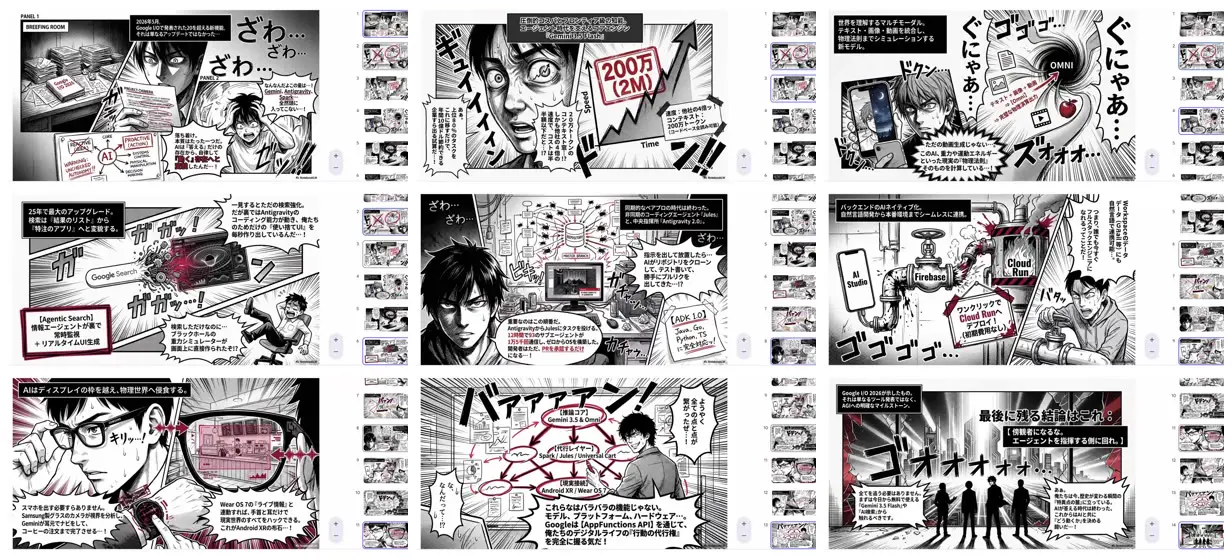
Black-and-white manga pages with heavy screentone and a single red accent, where wide-eyed, sweating characters react to each point under huge sound-effect lettering.
- Color
- Black ink and gray screentone on white, with deep red for arrows, circles, stamps, and highlighted labels.
- Type
- Giant hand-drawn sound effects (ざわ…, ゴゴゴ…, ガガッ, バアアアン!), boxed narration captions, and small typed Japanese in speech bubbles and labels.
- Framing
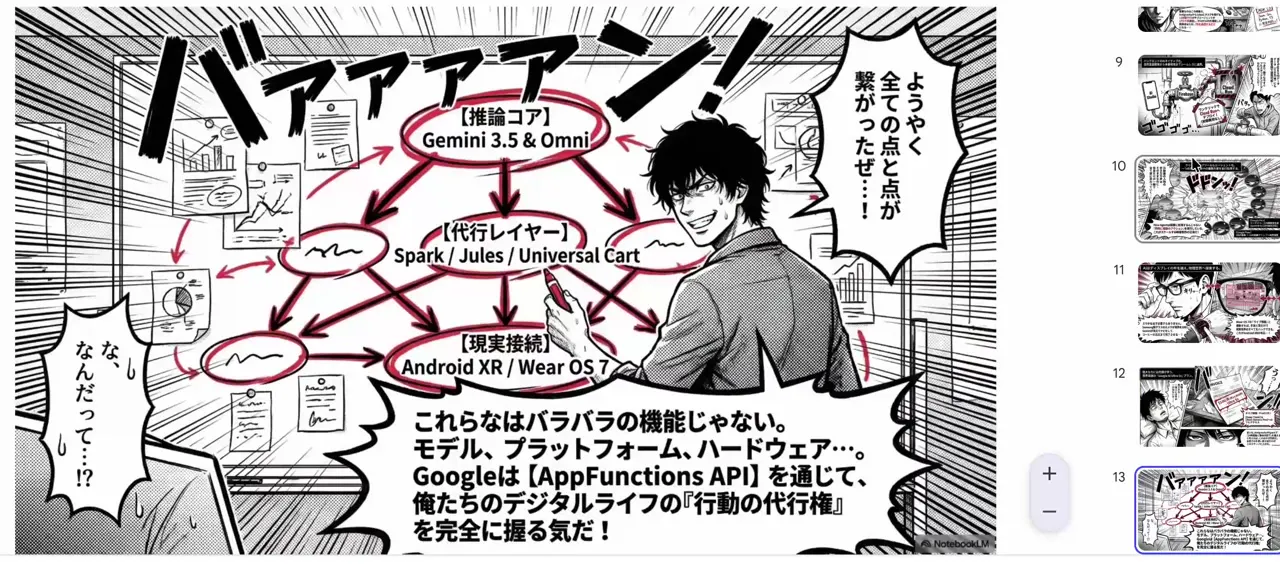
- Dense multi-panel layouts: extreme close-ups of eyes and faces, characters at desks, phones, and screens, and diagrams drawn into the scene, such as a rising graph, pipes, and a node map. NotebookLM's slide list runs down the right edge.
- Structure
- A briefing room on Google I/O 2026, Gemini 3.5 Flash's speed and 2M-token context, a multimodal Omni vortex, agentic search, coding agents (Jules, Antigravity 2.0), backend tools (AI Studio, Firebase, Cloud Run), smart glasses, a node map tying it together, and a closing line of silhouettes (最後に残る結論はこれ).