I'm gonna ask something weird, lets waste some tokens. Some of the pieces that we arrived into.. I love then, its a nice mix between synths and canons. I like Bach, love his math music and canon pieces. I like this palette of sounds. I want you to go into a side quest and compose a hardcore synth baroque piece. around 2:00 duration. Dont clobber this repo, so use a new folder here in the vm ~ But use the same fundsp pipeline we have. Keep the modern sounding drum kit, i let you chose tempo. Go hardcore into number of voices, pattern variations and superpositions. We don't want baroque sounding stuff in here [the game repo], this is just a tangent side quest just for my personal enjoyment, a musical artifact I want.

Please, maestro.
Yes, i Love it [the audio render]. Its weird as expected. Lets create a cool visualizer to go with it. Something mathy that expresses the complexity of the canon. Not a piano roll, that's too boring. Use some of your motion skills, be creative, you can represent yourself somewhere, maybe at the end. We might like colors too, canons are multicolor in my mind.
Make it yours. In The music, change "compose a hardcore synth baroque piece" and "around 2:00 duration" to your genre and length, and point "the same fundsp pipeline we have" at your own sound setup. In The video, keep "Something mathy that expresses the complexity of the canon. Not a piano roll" or describe your own visualizer.
Synth-baroque acid canon with a visualizer
A two-minute "hardcore synth baroque" canon with acid lines and modern drums, set to a multicolor visualizer of its voices. In Claude Code, Opus 5.5 wrote the score as a Python program, checked the counterpoint, and rendered it on a FunDSP synth engine.
“I'm using Claude Code and giving it access to a full linux computer, so it can use plenty of tools: synths, graphical libraries, programs made by itself.”
You'll need
- An existing synth pipeline for the agent to reuse (the prompt says "use the same fundsp pipeline we have")
- A machine or VM where Claude Code can install and run tools freely
How it was made
The creator calls this the partial prompt: both messages came at the end of a long Claude Code session polishing the generative soundtrack of their game, with a Rust/FunDSP synth engine, two drum kits, and a TB-303 voice already built. Claude Code had full access to a Linux VM. Between the prompts, Claude wrote the score as a program, checked the counterpoint with a script, measured the render since it can't hear, and fixed it over several passes. The visualizer is a small website, and LilyPond printed the scores. One custom skill, frontend-design, triggered on its own. Later prompts made a no-drums version, an organ arrangement, and a fugue.
Posted Oct 1, 2026 · r/ClaudeAI on Reddit · 827 upvotes · 124 comments
Prompt from: Post body, added in an edit under "The two prompts, verbatim (typos included)"
Look notesby Reference
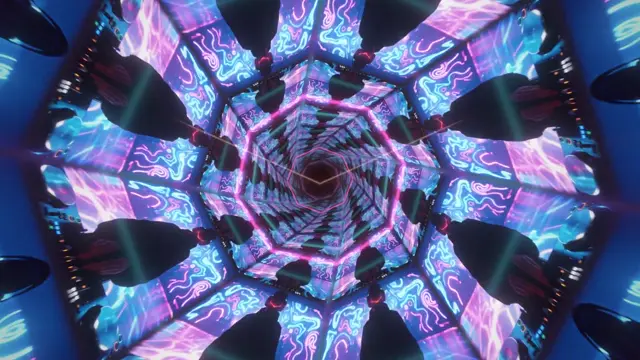
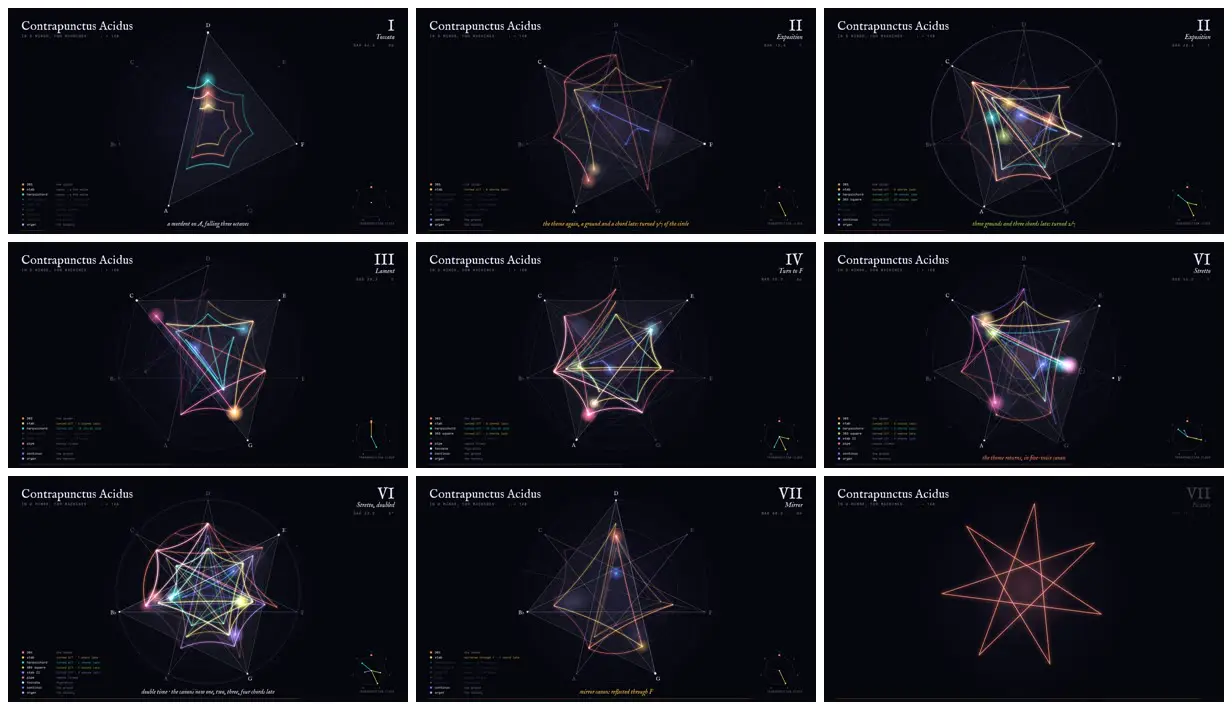
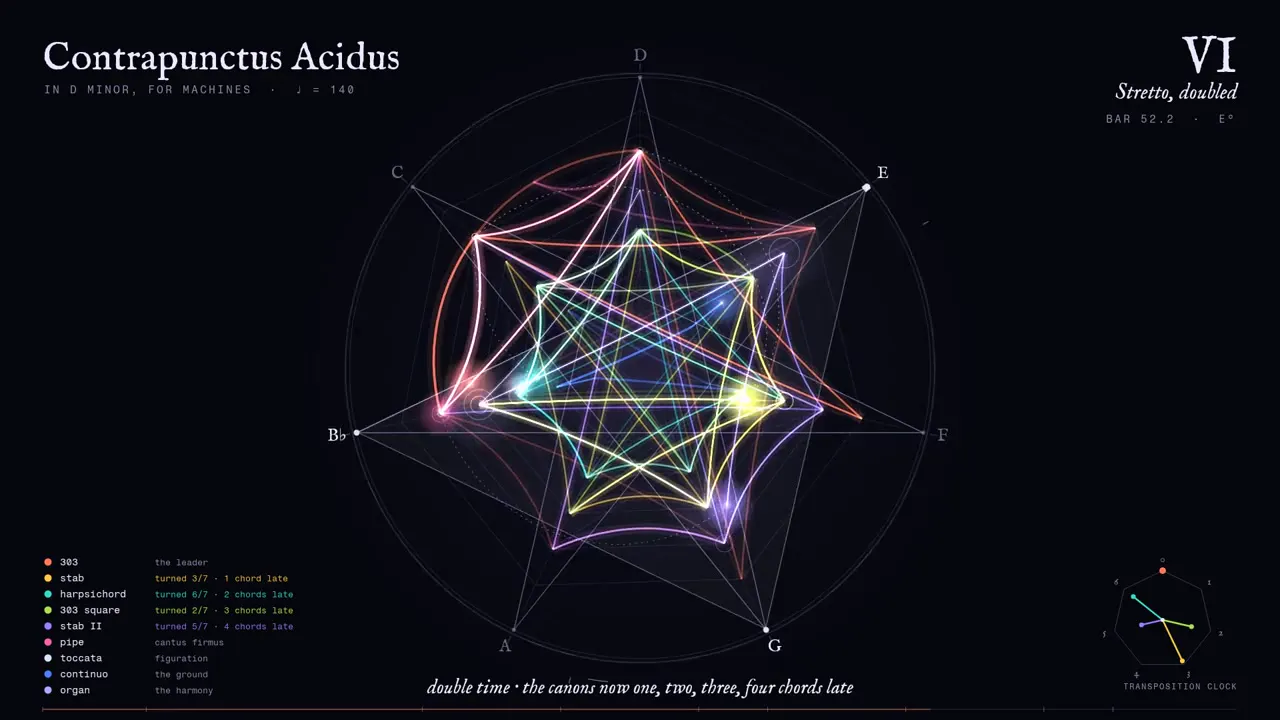
A dark, mathematical visualizer: glowing colored lines join the points of a seven-note pitch circle (D, E, F, G, A, B♭, C) and pile into star shapes in later sections, framed by a title, a section numeral, a voice legend, and a transposition clock.
- Color
- Near-black navy with neon coral, gold, teal, lime, violet, and pink lines, soft glows where they meet, and pale gray labels. The last frame is a single coral seven-pointed star.
- Type
- A classical serif title (Contrapunctus Acidus) and Roman numerals with italic section names (Toccata, Exposition, Lament, Turn to F, Stretto, Mirror, Picardy), small spaced capitals (IN D MINOR, FOR MACHINES · ♩ = 140, BAR 66.2), a monospace voice legend (303 the leader, stab canon · a 5th below, harpsichord canon · a 9th below, organ the harmony), and italic captions such as mirror canon: reflected through F.
- Framing
- 16:9 with the pitch circle centered, the title top left, the section numeral top right, the legend bottom left, a small TRANSPOSITION CLOCK bottom right, and a caption centered at the foot.
- Sound
- A canon rendered with a FunDSP synth engine, according to the creator. The on-screen legend lists 303, stab, harpsichord, pipe, toccata, continuo, and organ voices.
- Structure
- I Toccata with a few stacked lines (a mordent on A, falling three octaves), II Exposition (the theme again, a ground and a chord late), III Lament, IV Turn to F, VI Stretto (the theme returns, in four-voice canons) and Stretto, doubled with the densest web, VII Mirror (mirror canon: reflected through F), and VII Picardy ending on one coral seven-pointed star.