write a script in egyptian arabic, that i will use to give to google 3.8 flash tts tool, to generate a voice. the tool allows for giving a description to the voice and an expression for every sentence, take that into consideration when writing the script. I will then feed the voice back to you, to generate a motion graphics explainer for a high quality engaging production, like planet earth and these kinds of shows, about "How big is the universe, really?"
attached is the voice over for a script in egyptian arabic, that you will use to generate a motion graphics for adults about "How big is the universe, really?" Generate the motion graphics video to match the voice over timing perfectly, go all out and impress me. do not generate captions or subtitles. Use minimal background music and lower its volume so it's barely noticeable. The voice over and sound effects are more important than the music. the voice over is in the style of planet earth and these kind of documentaries, so the video you generate needs to match that style.
Make it yours. Change the topic in both prompts ("How big is the universe, really?"), the language ("egyptian arabic"), and the show to imitate ("like planet earth and these kinds of shows"). Keep "do not generate captions or subtitles" and the music line if the voice should lead.
Universe-scale documentary in Arabic
A 6-minute motion-graphics documentary on the scale of the universe, narrated in Egyptian Arabic in the manner of Planet Earth. Claude wrote a TTS-ready script, the creator voiced it in Google AI Studio, and Claude then built the visuals to that voice-over.
You'll need
- Google AI Studio, or another TTS tool that takes a voice description and per-line expressions, for the voice-over you generate between the two prompts
- The voice-over file, attached to the second prompt
How it was made
Run in Claude Cowork with Opus 5.5 at medium effort. The first prompt gets a script with a voice description and an expression for every line. The creator pastes it into Google AI Studio's voice tool, picks a voice, and generates the narration, then attaches the audio with the second prompt and lets Claude make the video. The creator says the video itself came from that single prompt, and that the prompts can be adapted or written in Arabic.
Little of the $20 Claude plan's usage, per the creator
Posted Sep 28, 2026 · X · 395 likes · 22k views · 12 comments
Prompt from: Self-reply on X: both prompts, in English, quoted in an Arabic post
Look notesby Reference
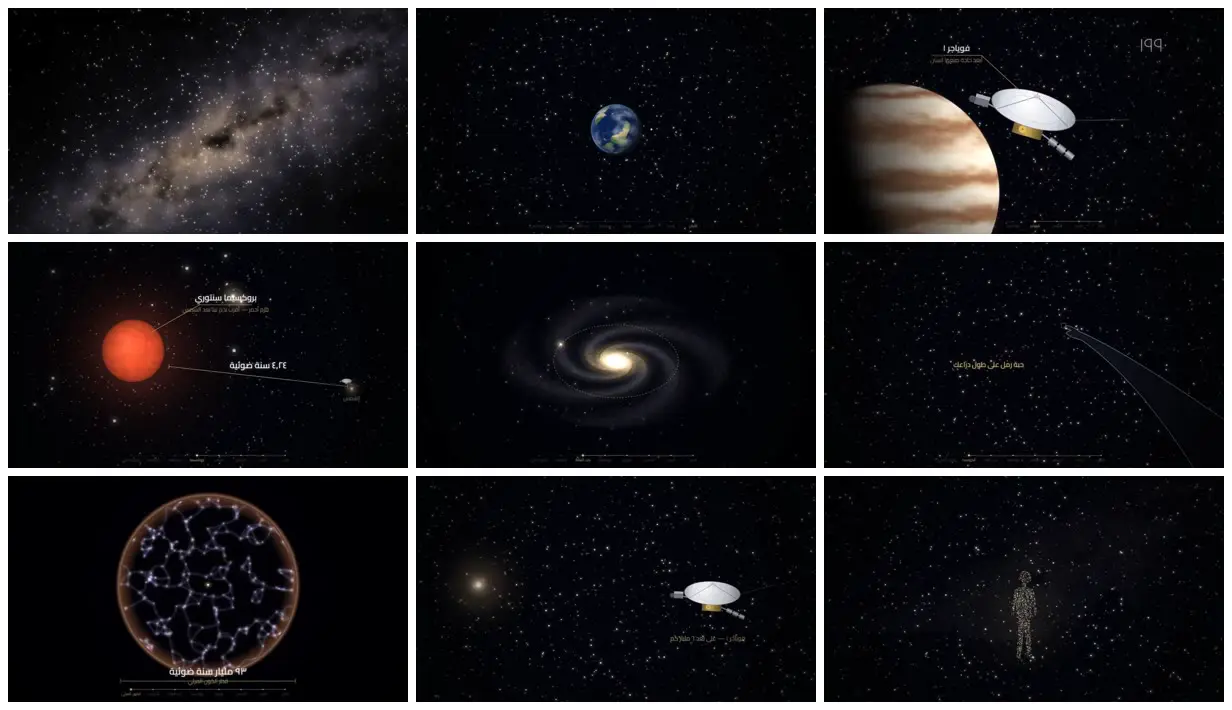
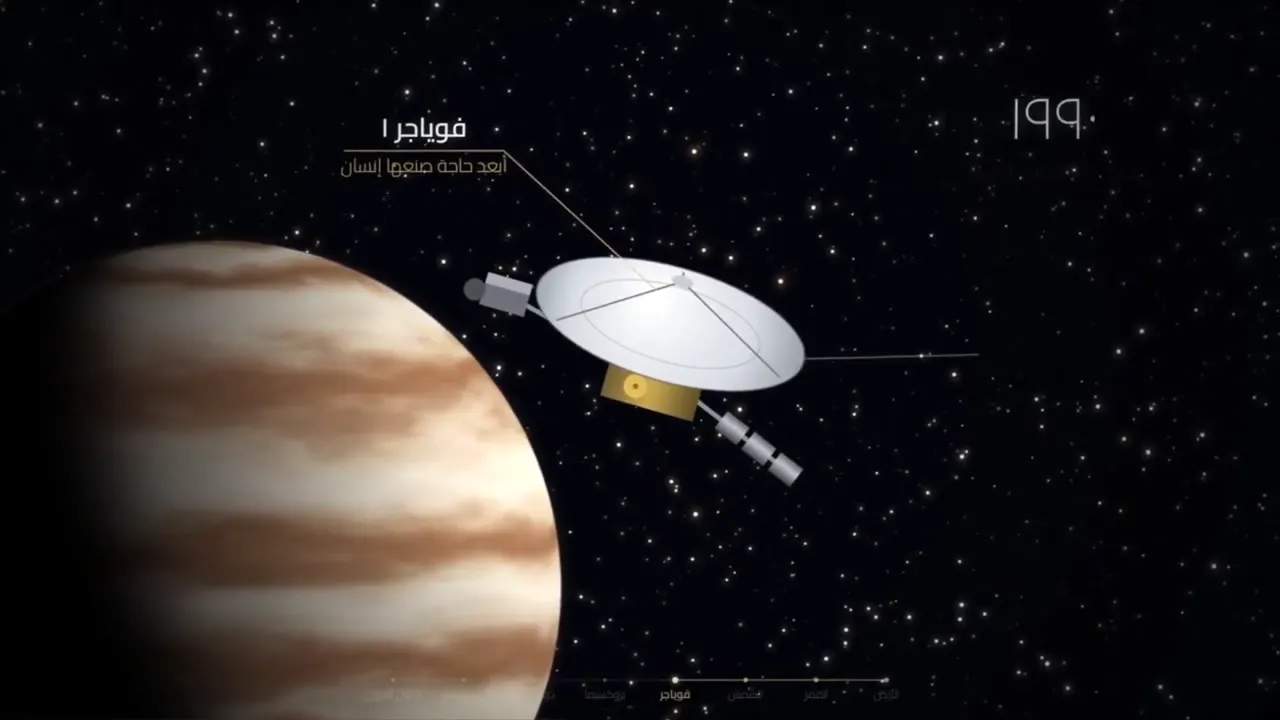
A dark, star-filled documentary that steps outward from Earth: Voyager passing a gas giant, Proxima Centauri, the Milky Way, the cosmic web, and back to a human figure made of stars, labeled in Arabic.
- Color
- Black space with white stars, the Milky Way's dusty beige, Earth's blue, a gas giant's cream and rust bands, Proxima's orange-red, and thin warm-gold labels and lines.
- Type
- Small Arabic labels in white and muted gold, attached to objects by thin leader lines; distances and dates in Arabic-Indic numerals, such as ٩٣ مليار سنة ضوئية (93 billion light-years) and ١٩٩٠ beside Voyager; and a hairline scale along the bottom with stops from الأرض (Earth) to الكون المرئي (the observable universe). No subtitles.
- Framing
- One subject at a time, centered or set to one side in a lot of black space, with labels hung from callout lines and the scale of stops along the bottom edge.
- Sound
- Egyptian Arabic narration that the creator generated with Google AI Studio's text-to-speech from Claude's script. The second prompt asks for sound effects, with music kept barely audible.
- Structure
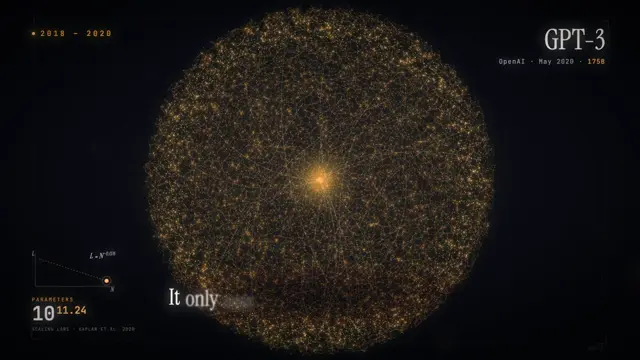
- The Milky Way across the sky, Earth alone, Voyager 1 passing a banded planet in 1990, Proxima Centauri 4.24 light-years away, the galaxy's spiral with the Sun's orbit marked, a grain of sand held at arm's length against the stars, the observable universe as a 93-billion-light-year sphere of filaments, Voyager again, and a human figure made of stars.