请担任科学纪录片导演、科学编辑、动态图形设计师和视频工程师,实际制作一部中文 AI 历史科普片。

片名:《学习的形状》
英文:The Shape of Learning
副标题:人工智能如何走到今天
交付:约 9 分 30 秒完整版,以及独立的 45 秒开场。
规格:16:9,1920×1080,24 fps,中文配音、中文字幕、原创配乐。

【核心创意】
用“一间不断改造的实验室”串联人工智能的发展。从一张手写数字卡出发,展示人类如何把规则、经验和反馈转化为机器能力。

每章按照“提出问题→方法运作→展示结果→遇到边界→引出下一问题”推进。让普通观众看懂过程,科技爱好者理解方法,科研观众能够核查证据。

【叙事结构】
1. 数字识别:规则、学习与留出测试。
2. 图灵与达特茅斯:把智能变成可研究的问题。
3. 符号、搜索与专家系统:把知识写成规则。
4. 神经网络与反向传播:从误差中学习。
5. 数据、算力与算法汇合:AlexNet 和深度学习。
6. AlphaGo:学习与搜索共同支持行动。
7. 注意力、Transformer 与语言模型:理解上下文,区分训练与推理。
8. AlphaFold 与科学验证:预测回到实验台接受检验。
9. 文献与制作片尾。

【视觉风格】
整体像一本被赋予运动的科学图册,结合实体实验器物和清晰矢量图解。

暖白纸面 #F1EEE6,石墨文字 #263B3E。
蓝色 #245E77 表示输入与数据。
黄铜金 #AF7D36 表示参数与计算联系。
陶土红 #B6533C 表示误差与问题。

使用纸卡、导轨、扫描门架、机械指针、网络、棋盘和词语连线。
材质为哑光陶瓷、纸张、拉丝黄铜;左上方柔光、柔和阴影、大面积留白。
镜头缓慢推进,关键原理停留,短交叠转场。
中文标题用宋体,图解用黑体,数字用等宽字体。
动画要展示状态和因果变化,避免无意义粒子、发光大脑和密集文字。

【科学要求】
核对关键年份与论文来源,保留不同研究路线长期并行的关系。
清楚标注历史资料、教学示意和真实实验。
训练曲线与预测结果读取实际运行的数据,不能编造。
注意力连线不代表真实思维;流畅回答不代表事实正确。
不暗示已有科研机构背书。

【声音】
使用免费中文神经网络配音方案,参考云希 zh-CN-YunxiNeural、语速 -12%。
语气沉稳、温和、好奇,逐段生成,按实际发音对齐字幕。
配乐采用稀疏钢琴或钟琴音色、柔和持续和弦及少量器物声,人声期间降低音乐。

【制作路线】
Remotion + TypeScript + SVG 制作图解与合成。
Blender + Python 制作实验器物动画。
Python + NumPy 运行教学实验。
edge-tts 生成配音,FFmpeg 完成混音、编码与检查。

先核对事实和旁白,生成配音并锁定时间线;制作并检查 45 秒开场,再扩展全片。
固定随机种子,按帧驱动动画,保存可编辑工程。

【交付】
完成完整视频、45 秒开场、SRT 字幕、章节表、旁白、参考文献与工程。
检查全片解码、声画时长、字幕重叠、文字遮挡、穿模及音频削波。
发现问题后修正并重新导出,最终交付实际可播放的成片。
Make it yours. Replace the title lines (片名, 英文, 副标题) and the nine chapters under 【叙事结构】 (story structure) with your own subject, and keep the 【视觉风格】 (visual style) block with its hex codes for the paper-and-brass look. To switch language, change 中文配音 and the Yunxi voice.
Chinese science film on the history of AI
A 9.5-minute Chinese science documentary, The Shape of Learning, on AI from digit recognition to AlphaFold, set in a lab that keeps being rebuilt. The prompt fixes the palette, fact-check rules, edge-tts voice, and a Remotion and Blender pipeline.
You'll need
- An agent that can run Node, Python, and Blender
- Remotion, Blender, edge-tts, and FFmpeg, as the prompt's production route lists
How it was made
The reply with the prompt opens by noting that Opus 5.5 and Claude Code can both be used directly on agent.space; it doesn't say which harness ran this film. The tools listed are the prompt's production route: Remotion with TypeScript and SVG for diagrams, Blender with Python for the lab props, NumPy for the teaching experiments, edge-tts for the voice, and FFmpeg for the mix. The prompt also asks for a separate 45-second opening, SRT subtitles, a chapter list, references, and the editable project; only the full film is posted.
Under $5 in tokens, per the creator, who compares it with more than 1,000 yuan for a video model like Seedance
Posted Sep 28, 2026 · X · 88 likes · 13k views · 6 comments
Prompt from: Reply on X
Look notesby Reference
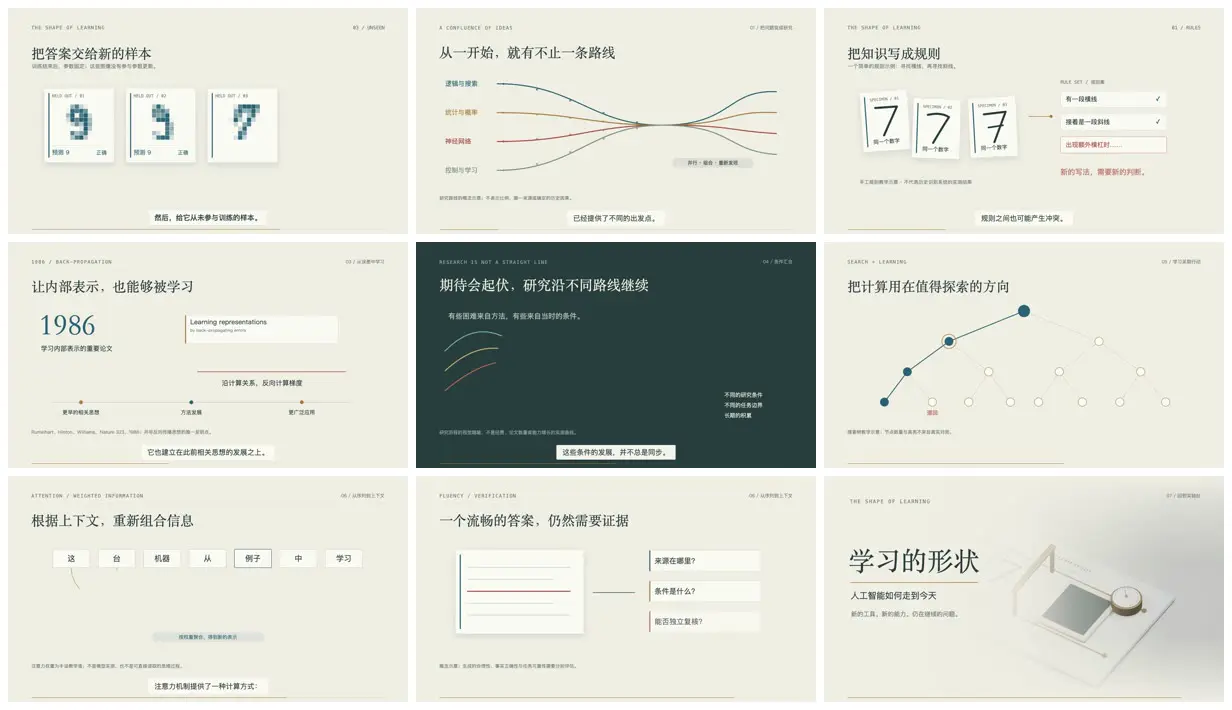
A calm, paper-toned Chinese science film built from clean diagrams: pixelated digit samples, converging research paths, handwritten 7s against a rule list, a 1986 back-propagation timeline, a search tree, attention over word tiles, and a source-check card, closing on a small brass-and-paper 3D lab model beside the title.
- Color
- Warm off-white paper with dark teal, brass gold, and brick-red accents, thin gray rules, and one dark teal-green slide; the last frame adds a soft 3D render in cream and brass.
- Type
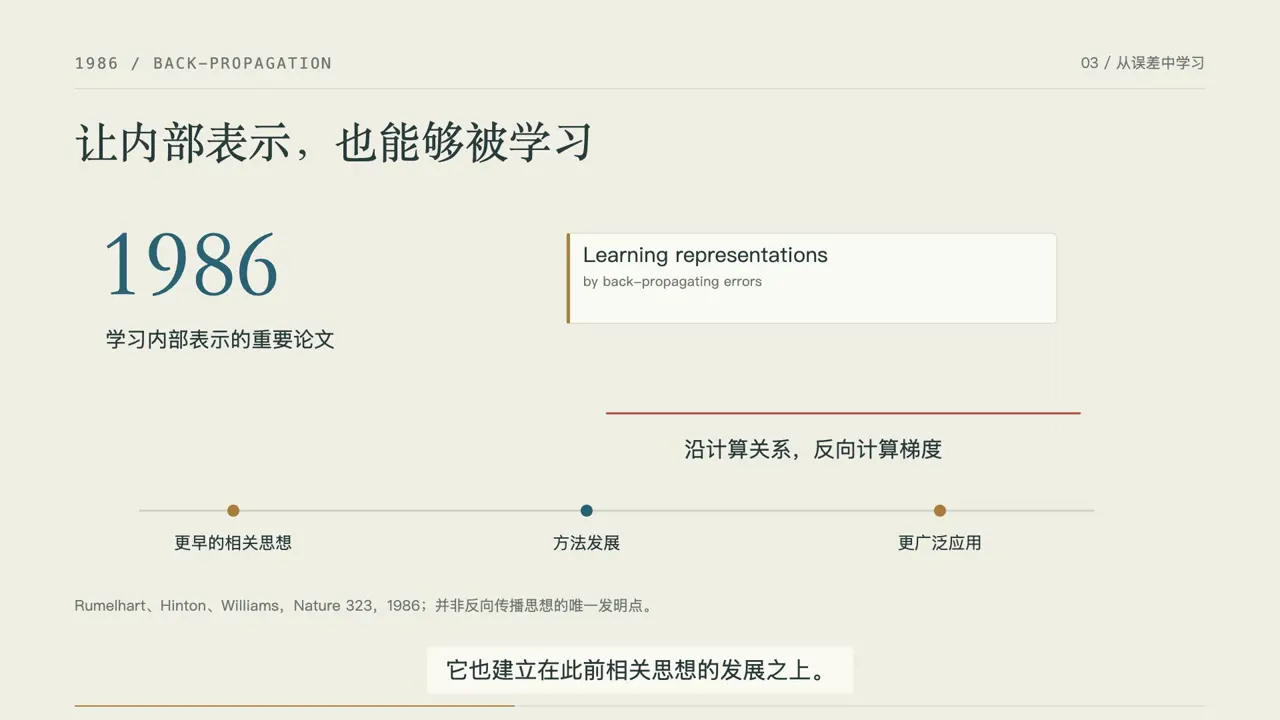
- Chinese headlines in a dark serif at top left ("从一开始,就有不止一条路线"), small spaced running heads along the top edge ("THE SHAPE OF LEARNING", "1986 / BACK-PROPAGATION", "RESEARCH IS NOT A STRAIGHT LINE") with chapter numbers at top right, and a boxed subtitle line centered at the bottom.
- Framing
- 16:9 slide layouts with wide margins: running head and headline at top left, one diagram in the middle of the page, a footnote at bottom left, and the subtitle box at bottom center over a thin gold rule.
- Sound
- Chinese narration in edge-tts's Yunxi voice, mixed with FFmpeg, as the prompt's production route sets out.
- Structure
- Held-out digit samples ("把答案交给新的样本"), four research lines meeting and parting ("从一开始,就有不止一条路线"), handwritten 7s checked against a rule set ("把知识写成规则"), a 1986 timeline citing Rumelhart, Hinton, and Williams, "期待会起伏,研究沿不同路线继续" on a dark green slide, a search tree with a backtrack ("把计算用在值得探索的方向"), word tiles regrouped by context, a fluent answer checked against three questions about its sources ("一个流畅的答案,仍然需要证据"), and the title card "学习的形状 人工智能如何走到今天" beside the lab model.