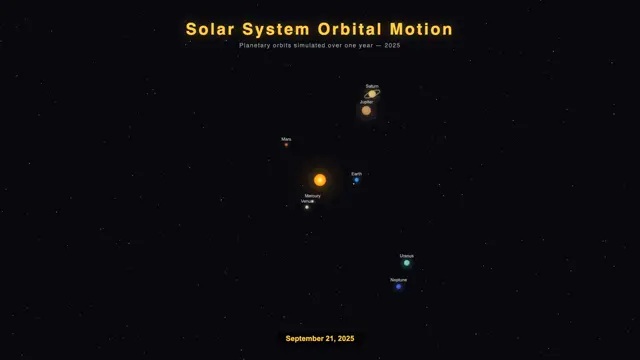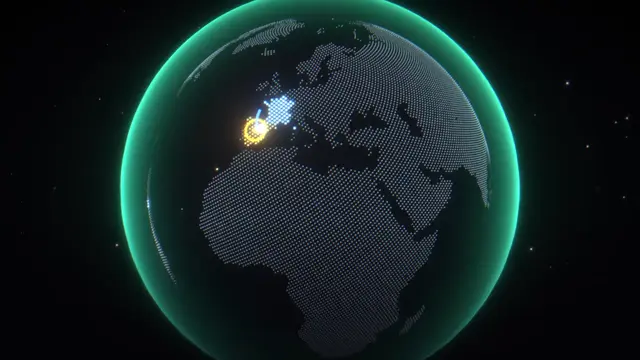
Every Kepler orbit is secretly a great circle. Start from Hamilton's hodograph: a planet's velocity vectors, placed tail to tail, always trace a perfect circle, even though its position traces an ellipse. Then show a family of orbits with the same energy (same long axis, different eccentricities): their velocity circles all pass through the same two points. Lift the velocity plane onto a sphere by stereographic projection and every one of those circles becomes a great circle hinged on those two points. Eccentricity turns out to be a tilt angle (e = sin alpha), a head-on fall toward the star passes through the north pole, and rotating the sphere turns one orbit into another of the same energy (Moser 1970; Fock 1935 found the four-dimensional version, which explains hydrogen's n^2 degeneracy). Planets must move with true Kepler timing and every number on screen must be exact.

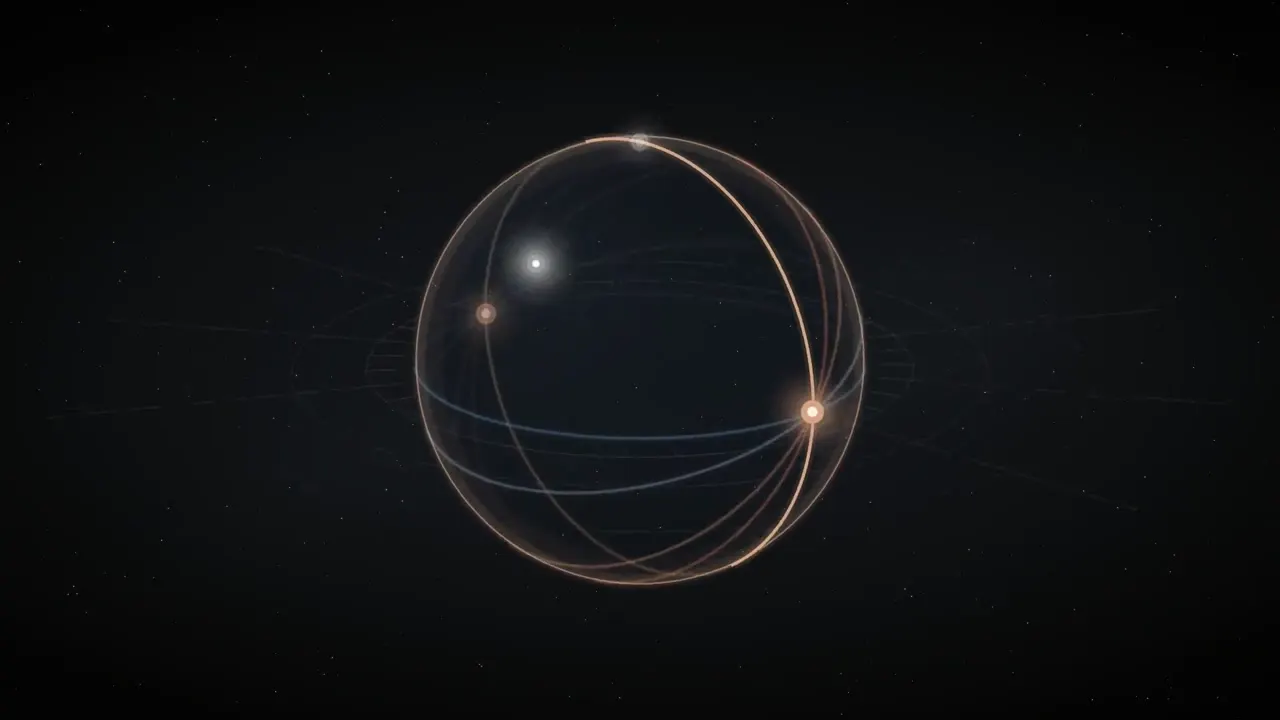
Art direction: an orrery at night. Ink-dark stage, brass and ivory linework, a lit glass sphere with Fresnel rim light and a soft specular highlight, great circles that dim when they pass behind the glass, a glowing star, planets with fading comet trails, a quiet starfield. Stunning 3D realism with the Mythos palette as the cast list.
Make it yours. Replace the mathematical claim in the first paragraph ("Every Kepler orbit is secretly a great circle") with your own, keeping the demand that "every number on screen must be exact". The "Art direction: an orrery at night" paragraph sets the look.
Every orbit is a great circle, in 3D Manim
A 166-second Manim film on a hidden symmetry of Kepler orbits: velocity circles of same-energy orbits lift onto a glass sphere as great circles, so eccentricity is the sine of a tilt. A Claude session wrote the brief and played all six agents in a pipeline.
- Claude Code
- Claude Opus 5.5
- Manim
- FFmpeg
- 29m render
You'll need
- The Math-To-Manim repo, to run the same chain (scripts/operate_mythos_chain.py)
- Manim Community Edition with LaTeX
How it was made
A Claude session was the model inside the repo's six-agent Mythos chain. It wrote this production request itself, answered each stage (intent, knowledge map, curriculum, math dossier, shot list, scene spec) and wrote the Manim scene; the harness's checks judged each reply. Four review passes over rendered contact sheets then changed the scene code. The commit is co-authored by Claude Opus 5.5 and links a claude.ai/code session. Every number on screen is checked by unit tests. The committed MP4 is a 30 fps re-encode of a 60 fps master.
Posted Sep 25, 2026 · HarleyCoops/Math-To-Manim on GitHub · 2.7k stars
Prompt from: Production request in the repo (docs/prompts), also in the run manifest
Look notesby Reference
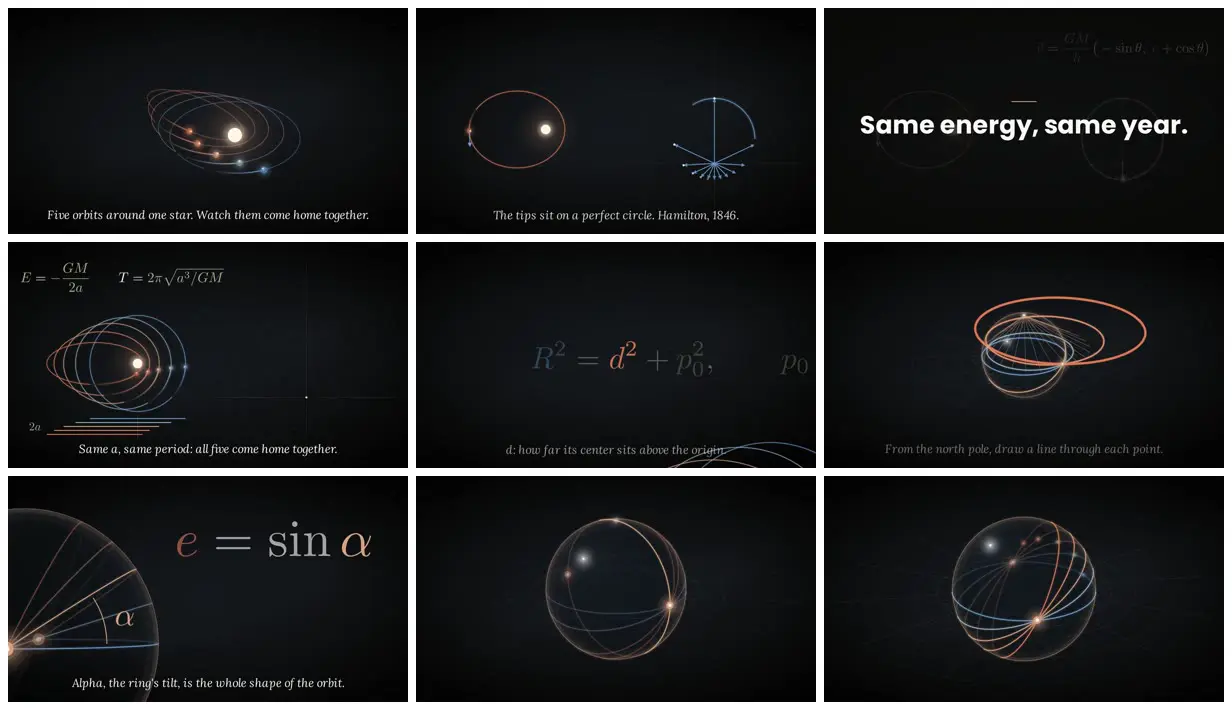
A dark, orrery-like Manim film: five colored orbits around a glowing star, velocity arrows whose tips sit on a circle, equation cards, and a lit glass sphere wrapped in coral and blue great circles.
- Color
- Ink-dark blue-black stage; coral-orange and pale blue linework, a warm white star, gold hinge points, and a soft glow on the glass sphere.
- Type
- Italic serif captions centered along the bottom ("The tips sit on a perfect circle. Hamilton, 1846."), LaTeX equations with color-coded terms (E = −GM/2a, e = sin α), and one bold sans-serif title card, "Same energy, same year."
- Framing
- One centered diagram per beat with a lot of dark space; equations top left or beside the figure; the later shots keep a single sphere at center frame.
- Structure
- Five orbits around one star, Hamilton's velocity circle, "Same energy, same year.", the period formula, the Pythagoras relation for the circles, the lift from the north pole, e = sin α, and then the sphere of great circles.