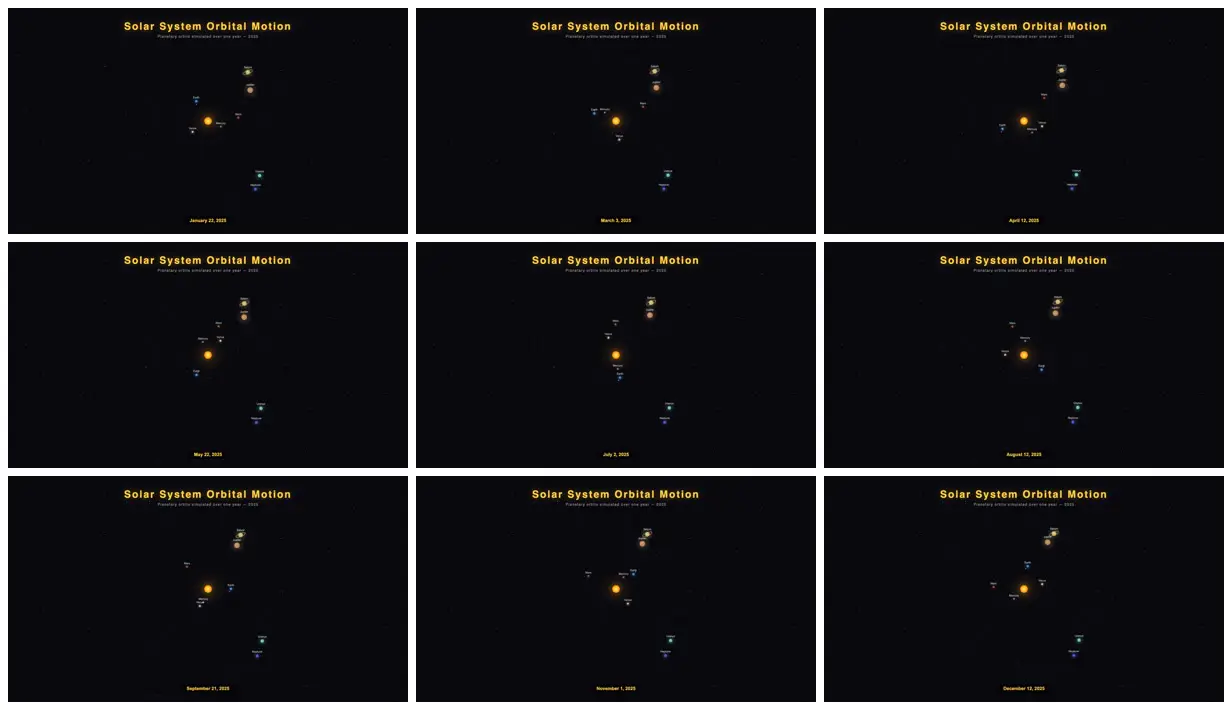
# Remotion Animation Prompt: Solar System Orbital Motion

## Prompt

Build me a solar system planet orbital animation video using Remotion with the following requirements:

### Basic Parameters
- Resolution 1920x1080, 30fps, 30 seconds total duration
- Simulate one full year of planetary motion in 30 seconds (starting from 2025-01-01)
- Output format: MP4

### Scene Content
- **Dark space background** (near-black #08090d) with 500 randomly scattered stars. Star positions must be deterministic across frames (use seeded pseudo-random like `Math.sin(i * 127.1 + 42)`, NOT `Math.random()`)
- **Sun at center** with radial gradient (bright white core → golden yellow → orange), surrounded by a large semi-transparent glow halo
- **8 planets** (Mercury, Venus, Earth, Mars, Jupiter, Saturn, Uranus, Neptune) orbiting the Sun in circular motion
- Each planet has its own color, size, and orbital period based on real astronomical data (J2000 epoch mean longitude)
- Orbit paths shown as very faint white circles (rgba 255,255,255, 0.08)

### Visual Details
- Each planet is a **radial gradient circle** (highlight offset upper-left, shadow lower-right), not a flat color circle
- Each planet has a **same-color semi-transparent glow halo** around it for presence
- **Saturn has rings** — rendered as a tilted ellipse stroke
- **Earth has a moon** — small white dot orbiting Earth with a 27.32-day period
- Each planet has a **name label** displayed above it (e.g. "Mercury", "Earth")

### Orbit Scaling Logic
- Inner planets (Mercury to Mars) use linear scaling, outer planets use **logarithmic compression**
- This ensures inner planets are clearly visible while outer planets stay within frame
- Formula: when au ≤ 1.6, radius = (40 + au × 70) × zoom; when au > 1.6, use log2 compression: radius = (40 + 1.6 × 70 + log2(au / 1.6) × 58) × zoom

### Animation & Overlays
- **No fade-in** — the very first frame should show the complete scene immediately, no gradual opacity transition
- **Title always visible**: Display "Solar System Orbital Motion" and a subtitle at the top center of the screen. The title must remain visible for the entire duration of the video, no fade-out, no entrance animation
- **Date display at bottom**: Show the current simulated date in real-time (e.g. "March 15, 2025"), displayed in a rounded pill with semi-transparent frosted-glass background, golden yellow text

### Technical Implementation Notes
- Use **Canvas 2D** to draw the sun, planets, stars, and orbit lines (not DOM elements). Redraw every frame inside a `useEffect` keyed on the frame number
- Title and date overlays use **HTML absolutely positioned on top of the Canvas** (for crisper text rendering)
- Use `useCurrentFrame()` + `interpolate()` to map frame number to day offset
- Font: system sans-serif or any clean sans-serif font

### Additional Requirements
- Register a second Composition called "InnerPlanets" with zoom set to 2.5, showing only 3 months of motion, for a close-up view of the inner planets
- Keep the project structure clean: planet data, math utilities, drawing functions, and overlay components should each be in separate files

---

## Expected Result

When scrubbing the timeline, you should see:
1. Mercury zipping around the Sun multiple times
2. Earth completing exactly one full orbit (one year)
3. Jupiter and Saturn barely moving (their orbital periods are measured in years/decades)
4. The Moon rapidly circling Earth
5. The title staying visible at the top throughout the entire video
6. The date at the bottom progressing from January 1 to December 31

The rendered MP4 can be used directly for science explainer videos, social media content, or as a background for digital avatar courses.
Make it yours. Change the subject in "Build me a solar system planet orbital animation video" and the start date "2025-01-01", or swap the list of 8 planets for moons or exoplanets. Keep the Technical Implementation Notes for deterministic Canvas 2D drawing.
One year of planetary orbits in 30 seconds
A 30-second solar-system animation of one year from 2025-01-01: eight planets on real orbital periods with log-compressed outer orbits, Saturn's rings, Earth's moon, and a running date. The structured Remotion prompt ends with an expected-result checklist.
You'll need
- A Remotion project, which the agent can create
How it was made
The showcase lists the tool as Claude Code and the model as "Opus4.6". Whether it took one prompt isn't stated.
Posted Mar 13, 2026 · Remotion Prompt Showcase on Website · 10 likes
Prompt from: remotion.dev Prompt Showcase submission
Look notesby Reference
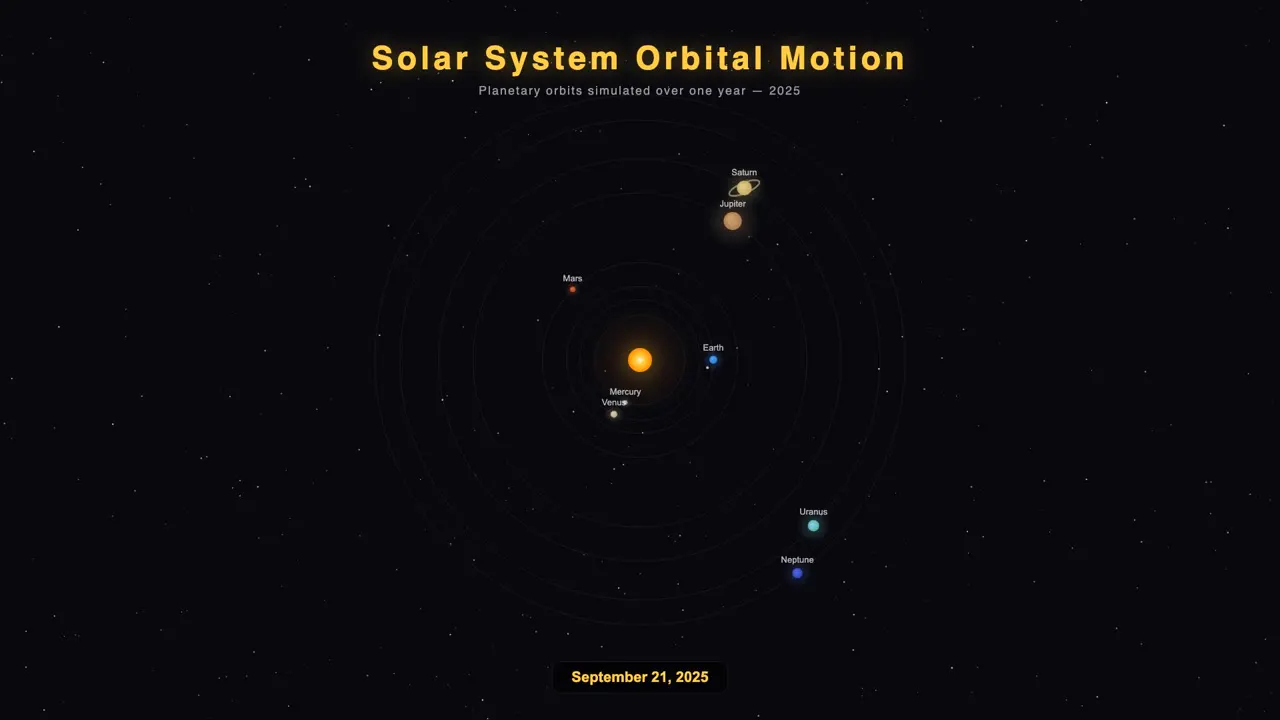
A top-down solar system on near-black: a glowing orange sun, eight small labeled planets on faint orbit rings, Saturn with a tilted ring, and Earth with a moon.
- Color
- Near-black space with sparse white stars, a golden-orange sun and title, and small planet colors from rust Mars to cyan Uranus and blue Neptune.
- Type
- A glowing gold title, "Solar System Orbital Motion", with the subtitle "Planetary orbits simulated over one year — 2025" at top center, small white planet labels, and a gold date in a dark rounded pill at the bottom ("July 2, 2025").
- Framing
- A centered 16:9 diagram with wide empty space. The inner planets cluster near the sun while Jupiter, Saturn, Uranus, and Neptune sit far out on compressed orbits.
- Structure
- One fixed view throughout while the date runs from January to December 2025 and the inner planets change position around the sun.