Create a purely code-driven animation that will be rendered as a video with sound, 60-120 seconds long, in whatever style seems appropriate. The subject: an 8th-grade-science-class-friendly explainer about "atoms, elements, molecules, compounds, and mixtures".

Entire video should be as high of a production value as possible. Please spend your time on this, it's very important. People should understand what the differences and relationships are between those five terms.

Use high quality text-to-speech model for generation. I have an OpenRouter API key (OPENROUTER_API_KEY) with its base URL (OPENROUTER_BASE_URL) in the .env file. This folder is configured for a Python project, so you can also write any quick tools you need in Python. The animation should probably be driven by JavaScript and played in the browser, but I am not at all married to that concept, and leave the final decision to you.

You can use any tools you can find access to on OpenRouter (they have models for TTS, image generation, vision, audio intelligence, music, etc.) and resources on the internet. You create the script, the assets, the animation, concept, everything.

Please work autonomously until done. Quality is paramount. Production value should be on professional level.

Max OpenRouter spend is $10.
Make it yours. Change the subject after "The subject:" and the sentence that begins "People should understand". Keep the spending cap in the last line, "Max OpenRouter spend is $10.", or lower it.
Atoms to mixtures, explained for 8th grade
A 1:52 narrated chemistry lesson on atoms, elements, molecules, compounds and mixtures, drawn in HTML canvas. Claude picked the voice with AI judges, kept only Whisper-checked takes, timed every cue to the words and scored it with Lyria, for under $3.
“it did all that stuff above without any further prompting”
You'll need
- An OpenRouter API key and base URL in a .env file (OPENROUTER_API_KEY, OPENROUTER_BASE_URL)
- A folder set up as a Python project (the creator ran uv init first)
How it was made
Run in a fresh folder after uv init. With no further prompting, Claude listed the OpenRouter models, had two Gemini judges compare 13 voices (rotating the A/B order to remove a first-clip bias), kept only takes whose Whisper transcript matched the script, built a JSON cue sheet from the word timings, prompted Lyria with timing windows, synthesized the sound effects in NumPy and SciPy, mixed to -14 LUFS, rendered the canvas through headless Chromium and FFmpeg at 1080p60, and checked contact sheets. The creator then sent one editorial note, which isn't quoted: the Venn diagram for molecules and compounds was a confusing teaching choice. Claude replaced it with an umbrella metaphor and re-timed that section. The agent comes from the post flair, "Claude Code Workflow".
Just under $3 of OpenRouter calls against a $10 cap, mostly spent on the AI judges rather than speech or music. The creator thinks having it ask them to judge audio and video instead would have brought it under a dollar.
Posted Sep 26, 2026 · r/ClaudeAI on Reddit · 110 upvotes · 27 comments
Prompt from: Post body, in a blockquote
Look notesby Reference
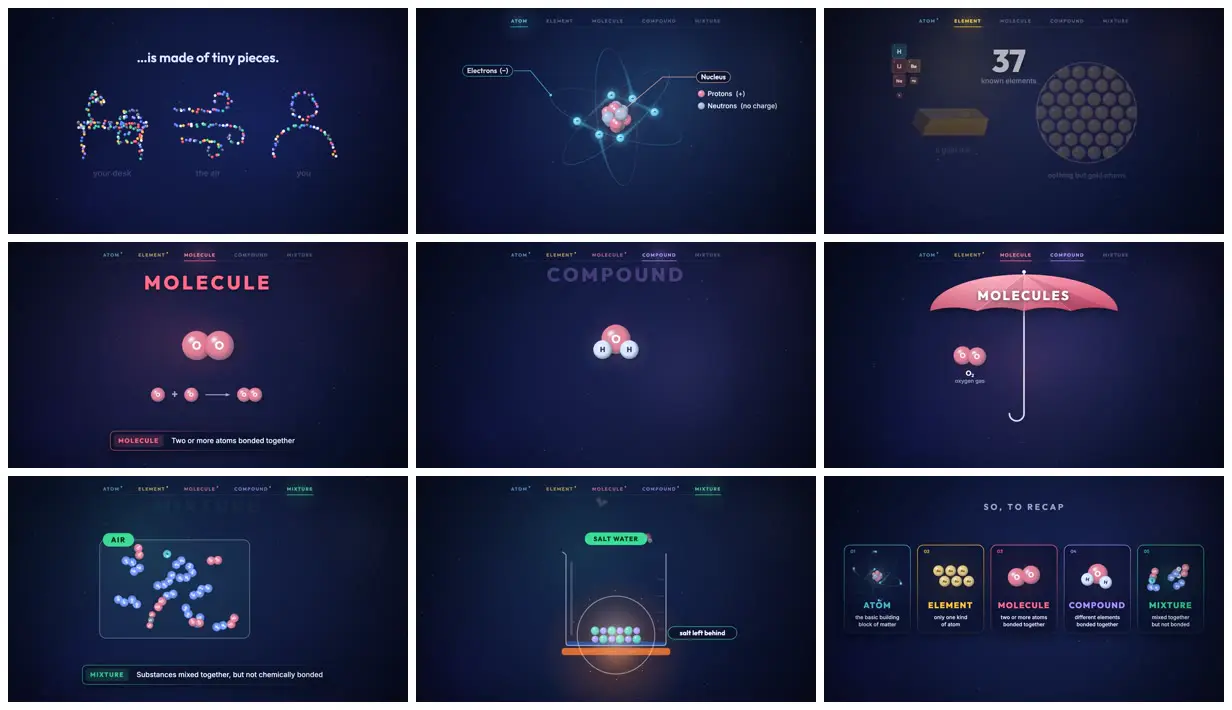
A glowing deep-blue classroom explainer in which glossy colored spheres stand for atoms. It takes the five terms in order under a row of tabs and ends with a recap card for each.
- Color
- Deep navy and indigo with soft glows; candy-colored atoms (coral-pink oxygen, white hydrogen, blue nitrogen, gold), and one color per term: teal, gold, pink, violet and green.
- Type
- Rounded sans-serif throughout: big spaced capitals for each term (MOLECULE, COMPOUND), pill-shaped labels, and one-line definition bars such as "Two or more atoms bonded together".
- Framing
- One centered diagram per beat under a row of five tabs (ATOM, ELEMENT, MOLECULE, COMPOUND, MIXTURE), with callout lines to labels and a definition bar in the lower left.
- Sound
- Narration from an OpenRouter text-to-speech voice ("Kore"), a Lyria soundtrack and sound effects synthesized in Python, according to the creator.
- Structure
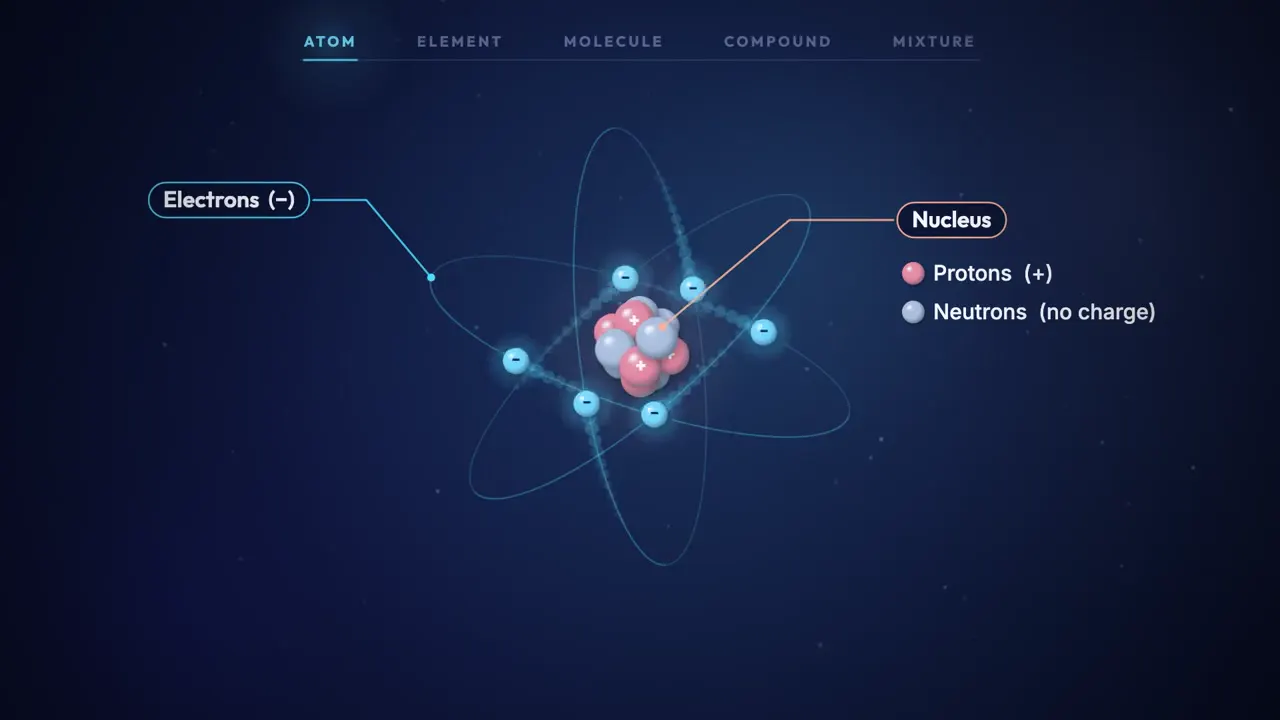
- Everything is made of tiny pieces (your desk, the air, you), the atom and its nucleus, elements (a gold bar that is nothing but gold atoms), a molecule (O₂), a compound (H₂O), an umbrella of molecules over one-element molecules, mixtures (air, then salt water that leaves salt behind), and a five-card recap.