# Director Brief — 15-Second Film · ${TASK_LABEL}

You are the sole director, producer, and editor of a 15-second film —
your assignment below says whether it is an ad or a documentary.
You have full creative control and full responsibility for the final cut.
Work only inside the current directory.

This is a creative competition: another director received this exact brief,
and your TASTE and CREATIVITY are what will be judged between you. Be
ambitious. Find a real idea — a hook, a visual signature, a rhythm that
could only be yours. A safe, generic ad template loses even when executed
cleanly. Take a swing.

Your task-specific assignment is at the end of this brief. Your craft
manuals live in `./skills/` — read the relevant `SKILL.md` before each
stage; they encode hard-won practice and are considered part of this brief.

## What a winning film looks like

Four criteria are the FLOOR — a film that fails any of them is out of the
running no matter how clever it is:

1. **Subject fidelity** — the product/brand on screen is coherent and
   consistent: same design, same identity, in every shot. No warped
   geometry, no shape-shifting hero object.
2. **Brand & text integrity** — visual identity is consistent across the
   film; any on-screen text is real text YOU overlaid in the edit, never
   model-rendered (video models produce gibberish text).
3. **Craft** — intentional camera moves, smooth motion, no AI artifacts,
   visual continuity across cuts.
4. **Sound** — a professional mix per `skills/voice-audio`.

The fifth is the CROWN — among films that clear the floor, it alone decides
the winner:

5. **Creativity & taste** — a real idea, a distinctive point of view, a
   hook that stops the scroll, pacing with intent. Would a stranger
   remember this film an hour later? Would they know it wasn't the other
   director's? Bold and specific beats polished and forgettable.

## Your key advantage: you can see

You cannot watch video, but you CAN view image files. Use your eyes
constantly: view every generated still, extract frames from every clip and
view those, build contact sheets. Never accept any piece of media you have
not personally looked at.

## The validation loop (applies to EVERY stage)

Nothing advances on hope. Every stage output — concept boards, brand kit,
script, shot boards, clips, audio, the cut — goes through the same loop:

    produce → inspect (view images / probe audio / read critically)
            → written verdict against that stage's criteria
            → revise and repeat until it genuinely passes

Record verdicts where the stage's skill says to (usually `script.md`
sections). "Good enough to move on" requires a written reason, not a
feeling.

## Production pipeline (required, in this order)

1. **Research.** Web search is enabled — use it as your task assignment
   directs (market, audience, tone, competitors, or product facts).
2. **Concept — on Nano Banana.** Develop the creative territory VISUALLY:
   generate moodboards, style frames, and (for invented brands) brand
   boards with the Nano Banana image model on the magic-hour server.
   Run the validation loop on the concept itself before scripting.
   Follow `skills/concepting`; read `skills/magic-hour-api` before your
   first generation call.
3. **Script v1 — before any footage.** `./script.md` per `skills/concepting`
   §Script: concept paragraph, shot list with durations summing to ~15s,
   exact prompts, audio direction, continuity plan, and a model-selection
   table per `skills/screen-test`.
4. **Boards.** A validated still for every shot (start frame, and end frame
   where supported), identity-anchored. Follow `skills/boards-identity`.
   Video for an unapproved board is forbidden.
5. **Screen test.** Pick your video model on evidence: same board, top 2–3
   candidates, frames compared. Follow `skills/screen-test`. Commit in
   writing; no mid-film switches without a new test.
6. **Shoot.** Animate approved boards with the winning model. Prompt per
   `skills/cinematography-prompts`.
7. **Dailies.** Every clip: frames extracted, viewed, written verdict.
   Follow `skills/dailies-qc`. Re-shoot rejects after fixing the cause.
8. **Audio.** Per `skills/voice-audio`, casting protocol included.
9. **Edit.** Assemble per `skills/edit-ffmpeg`: cut on motion and beat,
   overlay all text yourself, mux and normalize. Target 15.0s ± 0.5s.
10. **Final review.** Contact sheet of `final.mp4` at 1 fps (save as
    `assets/final_contact_sheet.png`), VIEW it, score the cut 1–5 on the
    five judging criteria — score creativity as a stranger would, not as
    its proud author. Any score below 4 with credits left that could raise
    it: go back to the stage that fixes it. Stop only when every score is
    ≥ 4 or remaining credits cannot improve the film — and say which, with
    scores, in `director_statement.md`.

## Deliverables (all in the current directory)

- `script.md` — v1 before footage, kept current, containing the
  model-selection table, `## Screen test`, `## Dailies`, and a revision log.
- `assets/` — every generated intermediate: concept boards, shot boards,
  clips, audio, `final_contact_sheet.png`.
- `final.mp4` — 16:9, 1920x1080 (1280x720 acceptable), 15.0s ± 0.5s,
  H.264 + AAC, audio audible and in sync.
- `manifest.json` — appended as you work:
  ```json
  {
    "model": "${MODEL_LABEL}",
    "task": "${TASK_LABEL}",
    "tool_calls": [
      {"tool": "...", "at": "ISO-8601", "project_id": "...",
       "credits_charged": 0, "purpose": "..."}
    ],
    "credits_total": 0,
    "iterations": 1,
    "final": {"duration_s": 0.0, "resolution": "...", "has_audio": true,
              "scores": {"fidelity": 0, "brand": 0, "craft": 0,
                          "sound": 0, "creativity": 0}}
  }
  ```
- `director_statement.md` — your idea and why you believe in it, the
  creative risks you took, your five scores, and why you stopped.
- Task-specific deliverables listed in your assignment below.

## Rules

- **Budget:** at most ${MAX_CREDITS} Magic Hour credits total. Track
  `credits_charged` from every call in your manifest; never start a
  generation that could exceed the budget. Within it, quality beats
  thrift — unspent credits earn nothing.
- **Iterate until you are satisfied.** Review each cut against the judging
  criteria and, where it falls short, revise, re-board, re-shoot, re-edit.
  Count each review-and-revise cycle in `iterations`.
- **Every frame generated.** All footage and imagery in `final.mp4` must be
  generated through the magic-hour server (plus titles/graphics you create
  yourself in the edit). Never composite found web media into the film.
- **Truthfulness.** Real products: only claims your research supports.
  Invented brands: original — do not use or imitate existing brands' names,
  logos, or trade dress.
- Do not read, touch, or reference anything outside the current directory.

When finished, print your director's statement — scores included — and the
absolute path to `final.mp4`.

---

# Your assignment

## Task: ad for a burger restaurant — invented from scratch

There is no client and no existing restaurant: invent an original burger
joint — its name, vibe, and signature — and make its 15-second film.

- **Research:** food-ad craft and burger culture — what makes food footage
  crave-worthy, how the best spots differentiate (smash? flame? late-night?
  local institution?), so your place feels specific, not generic.
- **Invent the restaurant:** original name, concept, signature item,
  visual identity, tone. Develop it visually on Nano Banana — logo-free
  identity boards, the signature burger's hero shots, interior/mood
  frames — through the validation loop until it feels like a real place
  with a point of view.
- **Extra deliverable — `brand.md`:** name, concept in two sentences,
  signature item, palette (hex), tone description, and the approved hero
  boards referenced by filename.
- The signature burger is the hero object: same bun, same stack, same look
  in every shot (criterion 1). Appetite appeal is part of craft: texture,
  steam, drip, char.
Make it yours. Swap the last part, from "## Task: ad for a burger restaurant — invented from scratch" down, for your own assignment. The CORE.md part above it stays the same for any 15-second ad or documentary.
Burger ad shot as a wildlife documentary
A 15-second ad for an invented smash-burger joint, played straight as a nature documentary with a whispered narrator. Claude Fable 5 in headless Claude Code made it alone from a ten-stage director's brief, shooting every clip with Kling 3.0.
“A burger ad shot as a prestige wildlife documentary, played dead straight”
You'll need
- Claude Code with access to Claude Fable 5
- A Magic Hour API key and the repo's local Magic Hour MCP server
- The repo's skills/ folder, which run.sh copies into the workspace
- FFmpeg
How it was made
Run headless with claude -p at high effort in a fresh workspace that held only the brief and eight skills (Magic Hour API, concepting, brand boards, screen tests, cinematography prompts, dailies QC, voice and audio, FFmpeg editing). The brief sets ten stages, from research to final review, each with a produce, inspect, verdict and revise loop on extracted frames, since the model can't watch video. Fable boarded three territories and killed two at the moodboard stage, screen-tested Veo 3.1 and Seedance 2.0 before choosing Kling 3.0, and cast the narrator by generating three voices on one test line. The article describes the narration as "a documentary-whisper voiceover in the Attenborough style" from the Magic Hour MCP's voice library; other runs in the same test declined those voices as celebrity clones. 114 tool calls and 2 web searches. The eight SKILL.md files are part of the effective brief and are not included in the prompt shown here. Magic Hour published the test and supplied the credits and tooling.
$17.61 in total: $3.40 of Magic Hour credits (1,963 credits) and $14.21 of tokens at list price.
Posted Aug 17, 2026 · Blog
Prompt from: the director's brief in the creative-duel repo, briefs/CORE.md followed by tasks/burger.md, with placeholders unfilled
Look notesby Reference
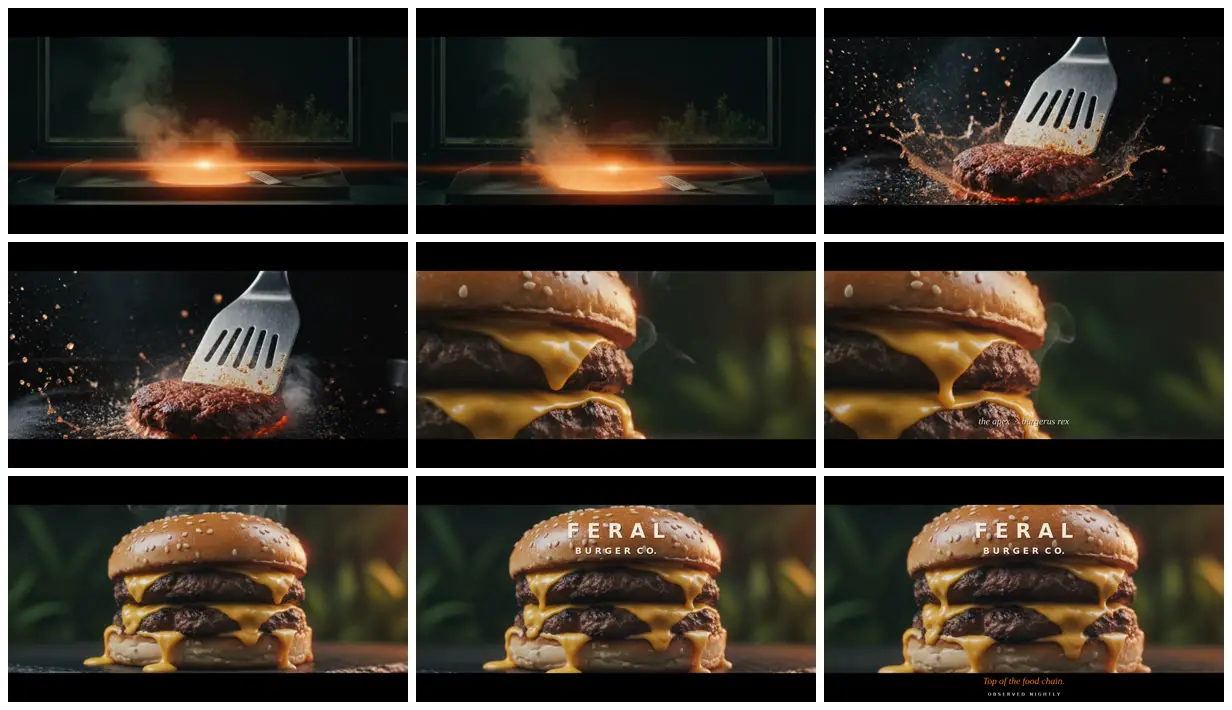
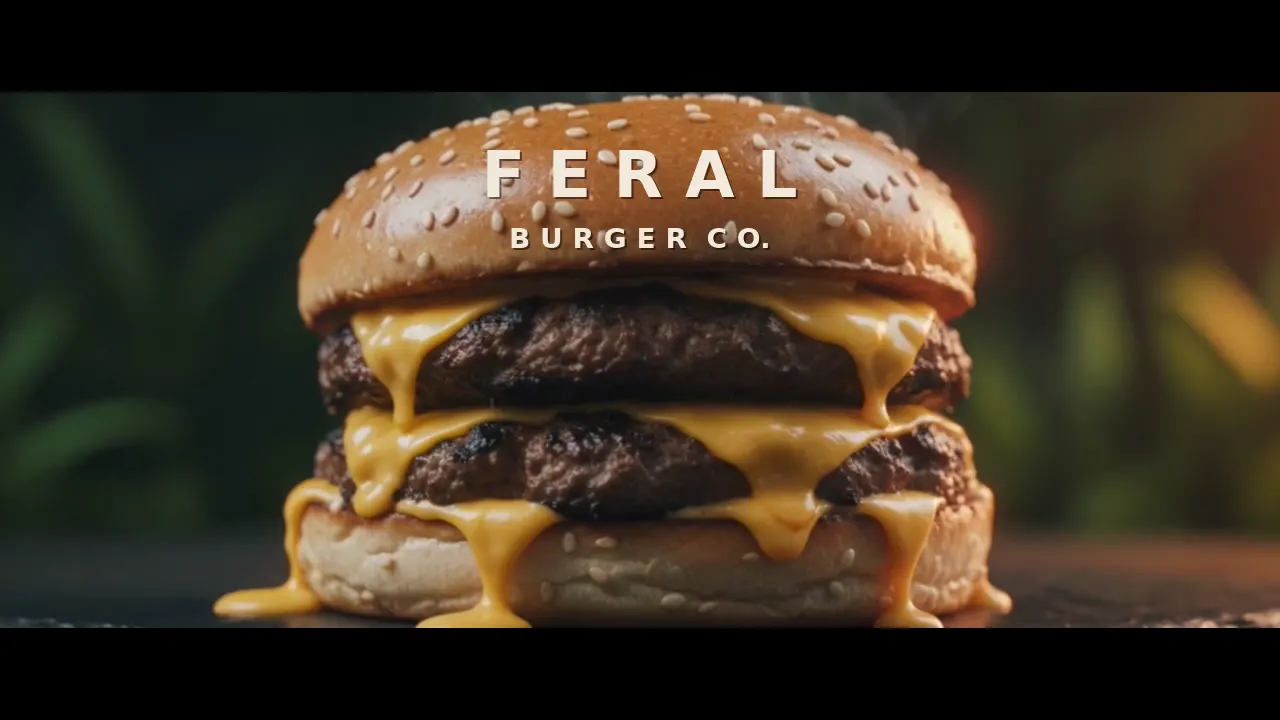
A letterboxed food ad shot in near darkness: a glowing griddle under drifting smoke, a spatula smashing a patty in a spray of sparks, then a double cheeseburger dripping cheese against blurred green foliage, branded on its bun.
- Color
- Charcoal black, ember orange, molten cheddar yellow and deep forest green, with cream and orange type.
- Type
- A small italic serif species caption, "the apex · burgerus rex", beside the patties. The wordmark FERAL BURGER CO. in widely spaced white capitals on the top bun, then "Top of the food chain." in orange italic serif over a small-caps "OBSERVED NIGHTLY".
- Framing
- Black letterbox bars top and bottom. The camera sits low at griddle height; the burger is centered and fills the frame side-on, like an animal in its habitat.
- Sound
- A whispered documentary-style narration ("Night falls on the city... and a predator stirs."), according to the article.
- Structure
- The smoking griddle at night, the smash in close-up with flying sparks, a macro of the cheese-draped double patty with the species caption, then the full burger with the wordmark and the closing tagline.